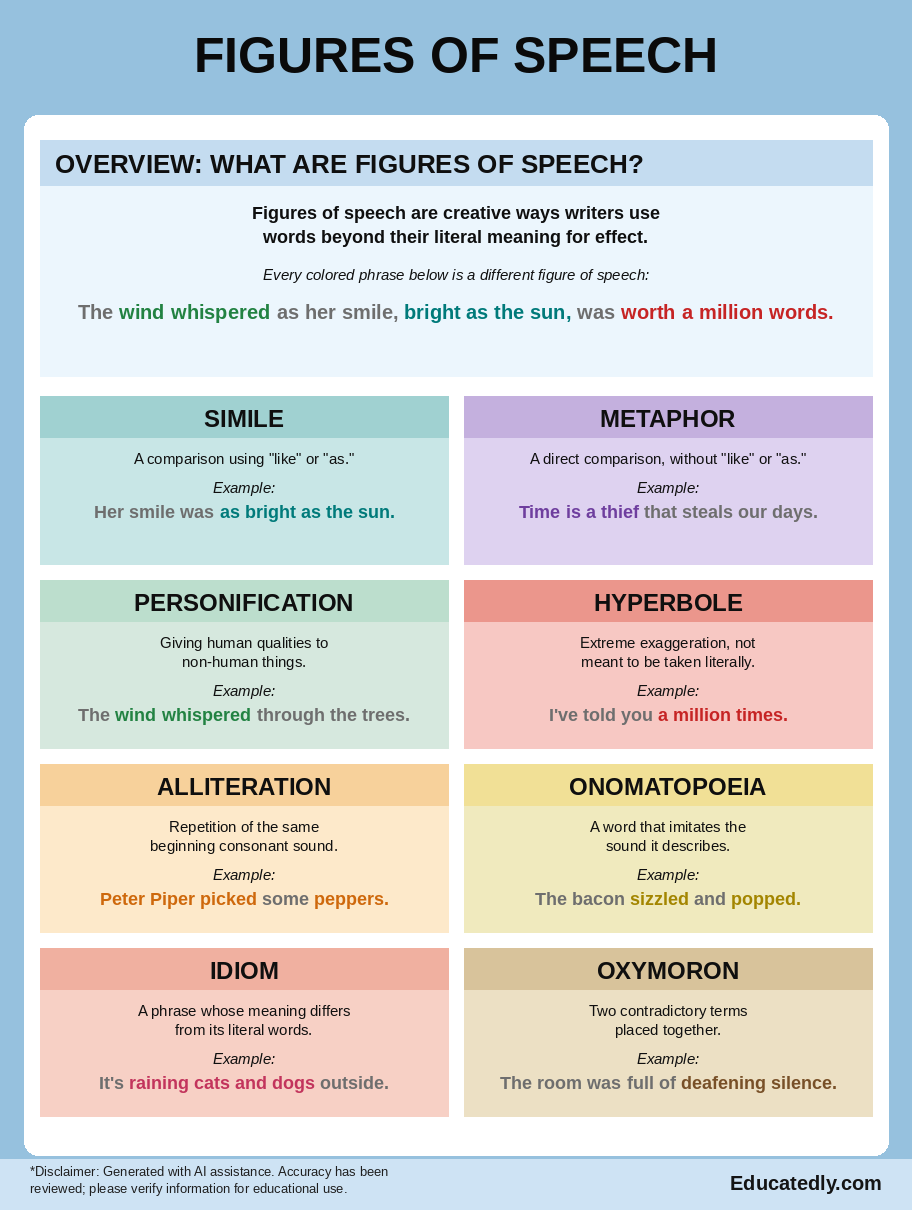
Writers rarely mean things word-for-word. When someone says “it’s raining cats and dogs” or “time is a thief,” they’re using figures of speech — creative ways of using language that go beyond literal meaning to create an image, add emphasis, or make writing more memorable. This guide covers eight of the most common figures of speech, with clear definitions and examples for each.
Download the Anchor Chart
📥 Download the Figures of Speech Anchor Chart (PDF) — print-ready, letter-size, no sign-up required.
Printing tips:
- Print at “Actual Size” or 100% scale (not “Fit to Page”) so the color-coded examples stay clear and correctly sized.
- Use cardstock (65–110 lb) if the chart will be posted on a wall or used often — it holds up far better than standard printer paper over a school year.
- Print in color; the color-coded examples are the fastest way to see each figure of speech in action within a real sentence.
Laminating tips:
- Laminate at 3 mil for a wall poster, or 5 mil if it’s going into student writing folders or getting handled daily.
- Trim close to the edge before laminating to avoid a wide clear border that peels over time.
- Laminate a second copy and pair it with a dry-erase marker so students can underline figures of speech in their own writing samples directly on the chart.
What Are Figures of Speech?
A figure of speech is a word or phrase used in a way that isn’t literal, in order to create a particular effect — a vivid image, an emotional punch, a bit of humor, or a memorable rhythm. Take this sentence:
“The wind whispered as her smile, bright as the sun, was worth a million words.”
That single sentence contains three figures of speech: personification (“the wind whispered”), a simile (“bright as the sun”), and hyperbole (“worth a million words”). Writers layer these devices constantly — often without readers even noticing — to make language more vivid and engaging.
Simile
A simile compares two unlike things using “like” or “as.”
Example: “Her smile was as bright as the sun.”
Similes are often the easiest figure of speech for students to spot, since the comparison word (“like” or “as”) is right there in the sentence.
Metaphor
A metaphor makes a direct comparison between two unlike things — without using “like” or “as.”
Example: “Time is a thief that steals our days.”
Metaphors are stronger and more direct than similes because they state that one thing is another, rather than saying it’s like another.
Personification
Personification gives human qualities, actions, or feelings to non-human things — animals, objects, or ideas.
Example: “The wind whispered through the trees.”
Wind can’t literally whisper, but describing it that way makes the scene feel alive and gives the writing a mood.
Hyperbole
Hyperbole is extreme exaggeration used for effect — it’s not meant to be taken literally.
Example: “I’ve told you a million times already.”
Nobody has actually said anything a literal million times. The exaggeration emphasizes frustration or repetition in a way a plain statement wouldn’t.
Alliteration
Alliteration is the repetition of the same beginning consonant sound across nearby words.
Example: “Peter Piper picked some peppers.”
Alliteration is common in tongue twisters, poetry, and titles because the repeated sound creates a pleasing rhythm.
Onomatopoeia
Onomatopoeia refers to words that imitate the actual sound they describe.
Example: “The bacon sizzled and popped in the pan.”
Words like sizzle, pop, buzz, and crash don’t just describe a sound — they sound like the thing they’re describing.
Idiom
An idiom is a phrase whose meaning is different from the literal meaning of its individual words.
Example: “It’s raining cats and dogs outside.”
No actual animals are falling from the sky — the idiom simply means it’s raining very heavily. Idioms are learned as whole phrases, since their meaning can’t be figured out word-by-word.
Oxymoron
An oxymoron places two contradictory terms side by side.
Example: “The room was full of deafening silence.”
“Deafening” and “silence” seem to contradict each other, but together they emphasize just how intense or noticeable the silence was.
Common Mistakes with Figures of Speech
- Confusing similes and metaphors. If the sentence uses “like” or “as,” it’s a simile. If it states one thing is another directly, it’s a metaphor.
- Mistaking any exaggeration for hyperbole. Hyperbole specifically refers to extreme, obviously unrealistic exaggeration — not just any overstatement.
- Taking idioms literally. Since idioms don’t mean what their individual words say, they’re often the trickiest figure of speech for English language learners.
- Missing personification when it’s subtle. Personification doesn’t always involve talking or feeling — verbs like “whispered,” “danced,” or “groaned” applied to non-human things count too.
Frequently Asked Questions
What’s the difference between a simile and a metaphor? A simile compares two things using “like” or “as” (“brave as a lion”), while a metaphor states one thing directly is another (“he is a lion in battle”). Metaphors tend to feel more direct and forceful than similes.
Is an idiom the same thing as a figure of speech? An idiom is one specific type of figure of speech — a fixed phrase whose meaning differs from its literal words. Other figures of speech, like similes and metaphors, aren’t fixed phrases and can be created freely.
Why do writers use figures of speech instead of just saying what they mean? Figures of speech create vivid mental images, add emotional weight, and make language more memorable than a flat, literal statement would. “Time is a thief” carries more feeling than “time takes things away from us.”
What’s a good way to teach figures of speech to students? Starting with one sentence that contains multiple figures of speech (like the example in this guide) helps students see how these devices work together in real writing, rather than memorizing definitions in isolation.
Quick Reference Summary
- Simile: compares using “like” or “as”
- Metaphor: direct comparison, no “like” or “as”
- Personification: gives human qualities to non-human things
- Hyperbole: extreme, obvious exaggeration
- Alliteration: repeated beginning consonant sounds
- Onomatopoeia: a word that imitates its sound
- Idiom: a phrase whose meaning isn’t literal
- Oxymoron: two contradictory terms together
Keep this guide alongside the Figures of Speech anchor chart for a quick visual reference whenever you need a refresher.
This article was created to accompany the Figures of Speech anchor chart. Content generated with AI assistance — accuracy has been reviewed, but please verify against your curriculum standards for classroom use.