Every word in a sentence has a job to do. Some words name things, some show action, some describe, and some connect ideas together. These jobs are called parts of speech, and English has eight of them. This guide breaks down all eight with clear definitions and examples, so you can use it as a teaching reference or a study guide.
Download the Anchor Chart
📥 Download the Parts of Speech Anchor Chart (PDF) — print-ready, letter-size, no sign-up required.
Printing tips:
- Print at “Actual Size” or 100% scale (not “Fit to Page”) so the color-coded example sentence and category panels stay clear and correctly proportioned.
- Use cardstock (65–110 lb) if the chart will be posted on a wall or handled often — it holds up far better than standard printer paper over a school year.
- Print in color; the color-coded panels and example sentence are the fastest way to see how a real sentence breaks down into its 8 parts.
Laminating tips:
- Laminate at 3 mil for a wall poster, or 5 mil if it’s going in student binders or writing folders where it’ll be handled daily.
- Trim close to the edge before laminating to avoid a wide clear border that peels over time.
- Laminate a second copy and pair it with a dry-erase marker so students can underline or label parts of speech in their own sentences directly on the chart.
What Are Parts of Speech?
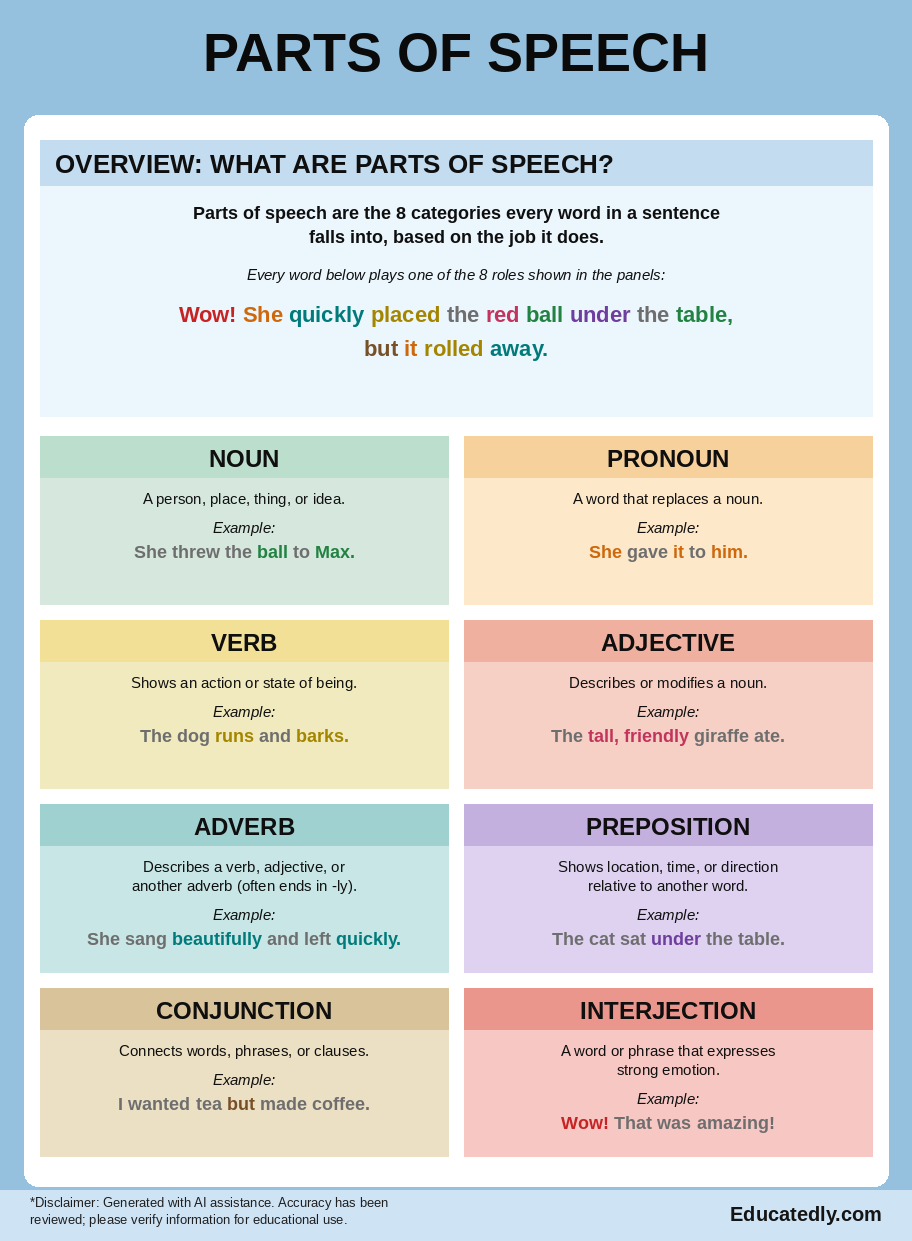
Parts of speech are the eight categories every word in a sentence falls into, based on the job it does. Take this sentence:
“Wow! She quickly placed the red ball under the table, but it rolled away.”
Every single word above plays one of the eight roles covered below — from the interjection (“Wow!”) to the conjunction (“but”). Once you can identify these eight categories, understanding sentence structure, fixing grammar mistakes, and building stronger sentences all get easier.
Noun
A noun is a person, place, thing, or idea.
Examples: teacher, classroom, pencil, happiness, Chicago
In a sentence: “She threw the ball to Max.” (ball and Max are both nouns)
Pronoun
A pronoun is a word that replaces a noun, so you don’t have to repeat it.
Examples: she, it, him, they, who, this
In a sentence: “She gave it to him.” (She, it, and him all stand in for nouns mentioned elsewhere)
Verb
A verb shows an action or a state of being.
Examples: run, jump, is, seems, think
In a sentence: “The dog runs and barks.” (runs and barks are the actions)
Adjective
An adjective describes or modifies a noun.
Examples: tall, blue, friendly, three, that
In a sentence: “The tall, friendly giraffe ate.” (tall and friendly describe the giraffe)
Adverb
An adverb describes a verb, an adjective, or another adverb — and often (though not always) ends in -ly.
Examples: quickly, very, well, often, beautifully
In a sentence: “She sang beautifully and left quickly.” (beautifully describes how she sang; quickly describes how she left)
Preposition
A preposition shows the relationship — often location, time, or direction — between a noun or pronoun and another word in the sentence.
Examples: under, before, between, with, during
In a sentence: “The cat sat under the table.” (under shows where the cat sat, relative to the table)
Conjunction
A conjunction connects words, phrases, or clauses.
Examples: and, but, or, because, although
In a sentence: “I wanted tea but made coffee.” (but connects the two contrasting ideas)
Interjection
An interjection is a word or short phrase that expresses strong emotion, often standing on its own.
Examples: Wow!, Ouch!, Yikes!, Hooray!
In a sentence: “Wow! That was amazing!” (Wow! expresses surprise, separate from the rest of the sentence)
Common Mistakes with Parts of Speech
- Confusing adjectives and adverbs. Adjectives describe nouns (“a quick fox”); adverbs describe verbs, adjectives, or other adverbs (“ran quickly”). Mixing these up is one of the most common grammar errors.
- Assuming all adverbs end in -ly. Words like fast, well, often, and never are adverbs too, even without the -ly ending.
- Mistaking a preposition for a conjunction. Both can appear mid-sentence, but a preposition connects a noun/pronoun to the rest of the sentence, while a conjunction connects whole words, phrases, or clauses.
- Forgetting that the same word can be different parts of speech in different sentences. “Run” is a verb in “I run every day” but a noun in “I went for a run.” Context determines the part of speech, not the word alone.
Frequently Asked Questions
How many parts of speech are there in English? There are eight: noun, pronoun, verb, adjective, adverb, preposition, conjunction, and interjection. Some grammar systems also list “article” or “determiner” as a separate category, though many traditional lists group these under adjectives.
What’s the easiest way to teach parts of speech? Using one full sentence and color-coding or labeling every word by its part of speech (like the example sentence in this guide) helps students see how the categories work together in real writing, rather than memorizing definitions in isolation.
Can a word be more than one part of speech? Yes. Many English words change part of speech depending on how they’re used in a sentence. “Light” can be a noun (“turn on the light”), a verb (“light the candle”), or an adjective (“a light backpack”).
What’s the difference between a preposition and a conjunction? A preposition connects a noun or pronoun to the rest of the sentence and usually starts a prepositional phrase (e.g., “under the table”). A conjunction connects two words, phrases, or clauses of equal importance (e.g., “tea but coffee”).
Quick Reference Summary
- Noun: person, place, thing, or idea
- Pronoun: replaces a noun
- Verb: shows action or state of being
- Adjective: describes a noun
- Adverb: describes a verb, adjective, or another adverb
- Preposition: shows relationship (location, time, direction)
- Conjunction: connects words, phrases, or clauses
- Interjection: expresses strong emotion
Keep this guide alongside the Parts of Speech anchor chart for a quick visual reference whenever you need a refresher.
This article was created to accompany the Parts of Speech anchor chart. Content generated with AI assistance — accuracy has been reviewed, but please verify against your curriculum standards for classroom use.