Exponents show up everywhere in math — from scientific notation to compound interest to computer science. Once you know the core rules, simplifying even complicated-looking expressions becomes fast and predictable. This guide breaks down every major exponent rule with worked examples, so you can use it as a teaching reference or a study guide.
Download the Anchor Chart
📥 Download the Rules of Exponents Anchor Chart (PDF) — print-ready, letter-size, no sign-up required.
Printing tips:
- Print at “Actual Size” or 100% scale (not “Fit to Page”) so the superscripts and formulas stay sharp and correctly sized.
- Use cardstock (65–110 lb) if the chart will be posted on a wall or handled often — it holds up far better than standard printer paper over a school year.
- Print in color; the color-coded panels (multiplication, division, power of a power, fractional exponents) make it much faster to scan for the rule you need.
Laminating tips:
- Laminate at 3 mil for a wall poster, or 5 mil if it’s going in student binders or getting handled daily.
- Trim close to the edge before laminating to avoid a wide clear border that peels over time.
- Laminate a second copy to keep at a teacher desk or small-group table as a quick-reference card during independent practice.
What Is an Exponent?
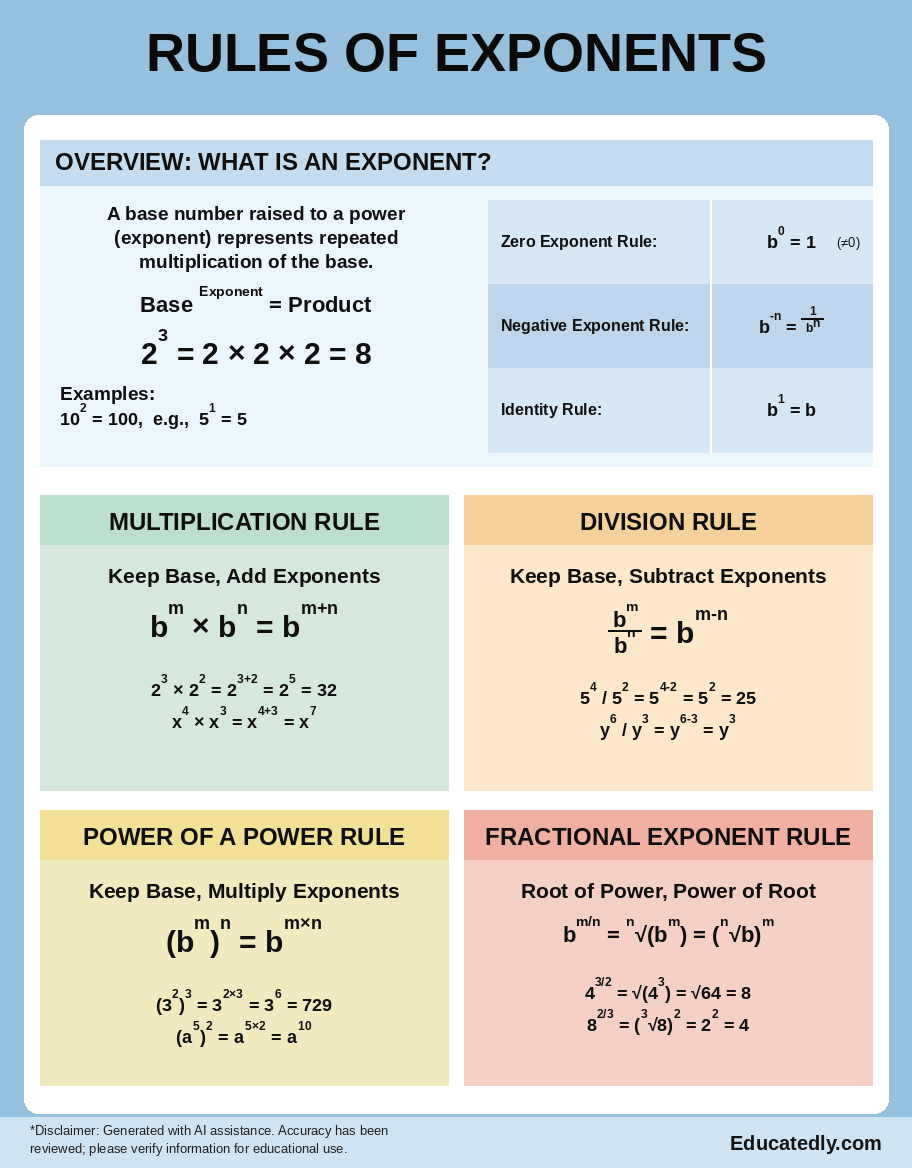
An exponent tells you how many times to multiply a base number by itself. In the expression base^exponent = product:
- The base is the number being multiplied
- The exponent (or power) tells you how many times to multiply it
- The product is the result
Example: 2³ = 2 × 2 × 2 = 8
More examples:
- 10² = 100
- 5¹ = 5
Three Foundational Rules
Before getting into the operations below, three quick rules are worth memorizing on their own:
- Zero Exponent Rule: Any nonzero base raised to the power of 0 equals 1. (b⁰ = 1, where b ≠ 0)
- Negative Exponent Rule: A negative exponent means “take the reciprocal.” (b⁻ⁿ = 1/bⁿ)
- Identity Rule: Any base raised to the power of 1 equals itself. (b¹ = b)
Multiplication Rule: Keep Base, Add Exponents
When multiplying two powers with the same base, keep the base and add the exponents together.
bᵐ × bⁿ = bᵐ⁺ⁿ
Examples:
- 2³ × 2² = 2³⁺² = 2⁵ = 32
- x⁴ × x³ = x⁴⁺³ = x⁷
This rule only works when the bases match — you can’t combine 2³ × 3² this way, since 2 and 3 are different bases.
Division Rule: Keep Base, Subtract Exponents
When dividing two powers with the same base, keep the base and subtract the exponents.
bᵐ / bⁿ = bᵐ⁻ⁿ
Examples:
- 5⁴ / 5² = 5⁴⁻² = 5² = 25
- y⁶ / y³ = y⁶⁻³ = y³
Notice this rule is the mirror image of the multiplication rule — multiplying adds exponents, dividing subtracts them.
Power of a Power Rule: Keep Base, Multiply Exponents
When a power is raised to another power, keep the base and multiply the exponents.
(bᵐ)ⁿ = bᵐˣⁿ
Examples:
- (3²)³ = 3²ˣ³ = 3⁶ = 729
- (a⁵)² = a⁵ˣ² = a¹⁰
A common way students remember this: multiplication “stacks” when you raise a power to a power, rather than adding like the multiplication rule above.
Fractional Exponent Rule: Root of Power, Power of Root
A fractional exponent represents a root. The denominator of the fraction tells you which root to take, and the numerator tells you what power to raise it to.
bᵐ/ⁿ = ⁿ√(bᵐ) = (ⁿ√b)ᵐ
Examples:
- 4^(3/2) = √(4³) = √64 = 8
- 8^(2/3) = (³√8)² = 2² = 4
Both forms of the rule give the same answer — you can take the root first and then raise it to the power, or raise it to the power first and then take the root. Whichever order involves smaller numbers is usually easier to compute by hand.
Common Mistakes with Exponent Rules
- Adding exponents when the bases are different. The multiplication and division rules only apply when the base is the same on both sides.
- Confusing “multiply the base” with “multiply the exponent.” In bᵐ × bⁿ, the base stays the same and the exponents add — the base itself is never multiplied by anything.
- Forgetting the zero-exponent rule. It’s easy to assume b⁰ should equal 0, but any nonzero base to the zero power equals 1.
- Mishandling negative exponents. A negative exponent doesn’t make the result negative — it means “take the reciprocal.” b⁻² = 1/b², not -b².
- Mixing up numerator and denominator in fractional exponents. In bᵐ/ⁿ, the denominator (n) is the root, and the numerator (m) is the power — reversing them gives the wrong answer.
Frequently Asked Questions
What is the easiest way to remember the exponent rules? Think of it as three pairs: multiplying powers adds exponents, dividing powers subtracts exponents, and raising a power to a power multiplies exponents. All three only work when the base stays the same.
Why does any number to the zero power equal 1? It follows from the division rule: bⁿ / bⁿ = bⁿ⁻ⁿ = b⁰, and any nonzero number divided by itself equals 1. So b⁰ must also equal 1.
What does a negative exponent actually mean? It means “reciprocal.” b⁻ⁿ = 1/bⁿ. For example, 2⁻³ = 1/2³ = 1/8, not -8.
How do fractional exponents relate to roots? The denominator of a fractional exponent tells you which root to take. b^(1/2) is the square root of b, and b^(1/3) is the cube root of b.
Quick Reference Summary
- Multiplication: bᵐ × bⁿ = bᵐ⁺ⁿ (same base, add exponents)
- Division: bᵐ / bⁿ = bᵐ⁻ⁿ (same base, subtract exponents)
- Power of a Power: (bᵐ)ⁿ = bᵐˣⁿ (same base, multiply exponents)
- Fractional Exponents: bᵐ/ⁿ = ⁿ√(bᵐ) = (ⁿ√b)ᵐ (root of power, power of root)
- Zero Exponent: b⁰ = 1 (b ≠ 0)
- Negative Exponent: b⁻ⁿ = 1/bⁿ
Keep this guide alongside the Rules of Exponents anchor chart for a quick visual reference whenever you need a refresher.
This article was created to accompany the Rules of Exponents anchor chart. Content generated with AI assistance — accuracy has been reviewed, but please verify against your curriculum standards for classroom use.