Elements of an IEP: A Teacher-Friendly Guide to Writing an Effective IEP
An Individualized Education Program, commonly called an IEP, is more than a document that schools complete once a year. A well-written IEP provides a roadmap for supporting a student with a disability and helping that student make meaningful progress in school.
For teachers, special education staff, administrators, and families, understanding the elements of an IEP can make the IEP process much easier to navigate.
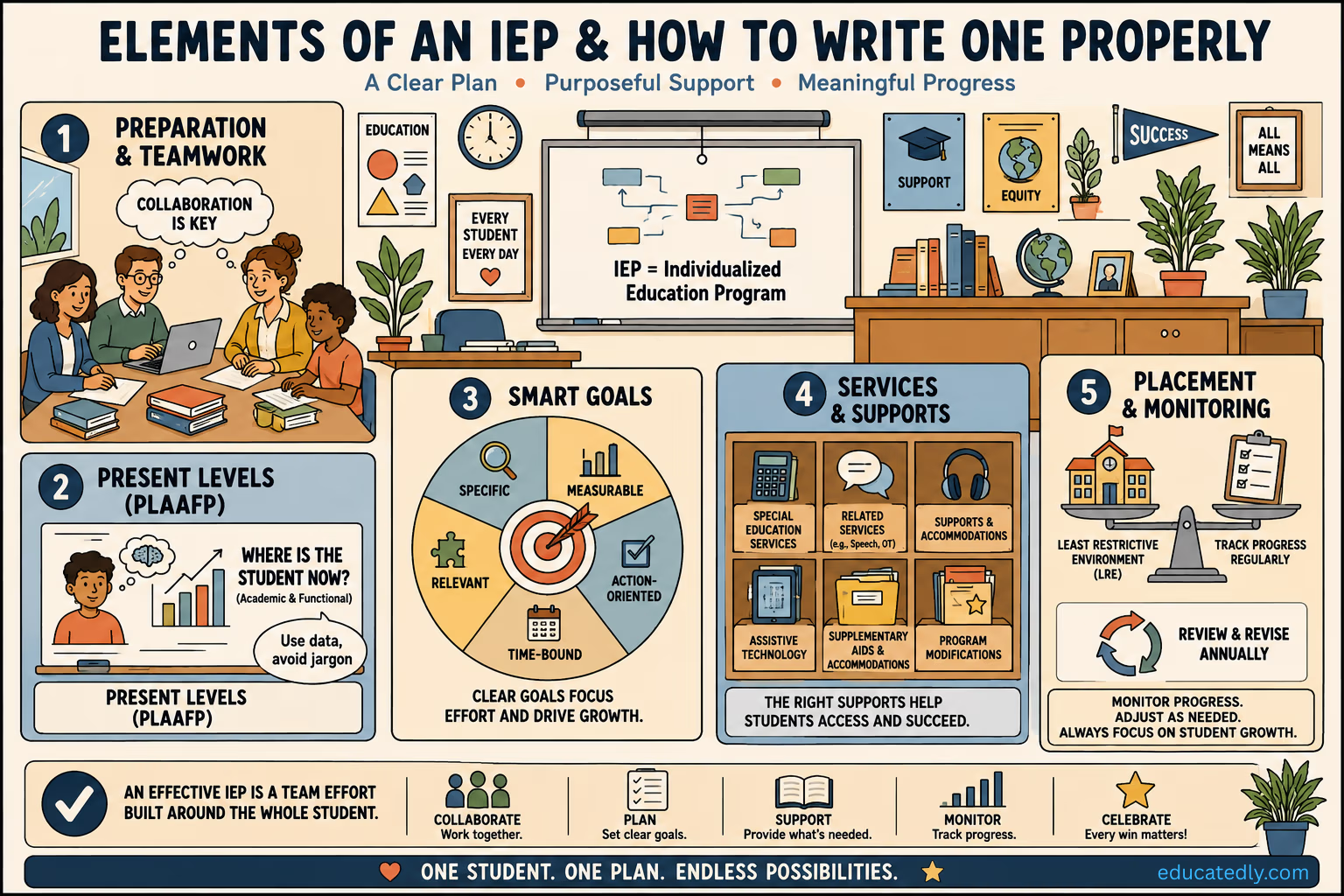
A strong IEP connects several important pieces:
- Preparation and teamwork
- Present Levels of Academic Achievement and Functional Performance (PLAAFP)
- Measurable annual goals
- Special education services, related services, accommodations, and supports
- Placement and progress monitoring
These pieces should work together. The student’s present levels should help drive the goals. The goals should help determine the services and supports. Progress monitoring should show whether those supports are working.
The Individuals with Disabilities Education Act (IDEA) establishes federal requirements for what an IEP must contain, including present levels, measurable annual goals, progress measurement, services and supports, and information about participation with nondisabled students.
What Is an IEP?
An Individualized Education Program is a written plan developed for an eligible student with a disability. It is designed around the student’s individual educational needs rather than using a one-size-fits-all approach.
The word individualized is important.
An effective IEP should answer questions such as:
- Where is the student performing right now?
- How does the student’s disability affect learning and participation?
- What does the student need to learn next?
- What measurable progress should the student make?
- What instruction, services, accommodations, and supports are needed?
- How will the team know whether the student is making progress?
The IEP is developed, reviewed, and revised by the IEP team. Federal law requires the IEP to include specific information about the student’s academic and functional performance, annual goals, progress measurement, services, supports, and participation in the general education environment.
1. Preparation and Teamwork: Collaboration Is Key
Before writing an IEP, the team needs good information.
An IEP should not be based on one test score, one teacher’s opinion, or a single classroom observation. The team should consider relevant information about the student’s current performance and educational needs.
The IEP process is fundamentally collaborative.
Depending on the student and circumstances, the team may include parents or guardians, general education teachers, special education teachers, school administrators, related-service providers, and other individuals with knowledge or expertise relevant to the student.
What information should the team consider?
Useful information may include:
- Classroom assessments
- Curriculum-based measurements
- State and district assessments
- Progress-monitoring data
- Work samples
- Teacher observations
- Previous IEP goals and progress
- Evaluation results
- Related-service information
- Parent input
- Student input, when appropriate
- Classroom performance and behavior data
Federal special education law specifically recognizes the importance of reviewing existing evaluation data, including information from parents, classroom assessments and observations, teachers, and related-service providers.
A practical rule for teachers
Bring data, not just descriptions.
Instead of:
“Jordan struggles with reading.”
Consider:
“When given a grade-level informational passage, Jordan currently answers 5 out of 10 comprehension questions correctly independently.”
The second statement gives the team something measurable to work with.
2. Present Levels: Where Is the Student Now?
One of the most important parts of an IEP is the Present Levels of Academic Achievement and Functional Performance, commonly called PLAAFP.
Think of PLAAFP as the starting point.
Before setting a destination, you need to know where the student is now.
Federal regulations require the IEP to describe the child’s present levels of academic achievement and functional performance and explain how the disability affects the student’s involvement and progress in the general education curriculum.
What should a PLAAFP include?
A useful PLAAFP should describe the student’s current strengths and needs using specific, relevant information.
Academic areas might include:
- Reading
- Writing
- Mathematics
- Listening comprehension
- Communication
- Academic vocabulary
- Organization
- Study skills
Functional areas may include:
- Communication
- Social skills
- Behavior
- Attention
- Executive functioning
- Self-advocacy
- Mobility
- Independent living skills
The exact areas will depend on the student’s individual needs.
Strong PLAAFP writing
A strong PLAAFP generally answers three questions:
1. What can the student do now?
2. What does the student struggle with?
3. How does the disability affect participation and progress in school?
For example:
“Maria independently identifies the main idea of a short passage with 80% accuracy when the passage is read aloud. When reading independently, she identifies the main idea with 45% accuracy and frequently selects supporting details instead of the central idea.”
This gives the team useful information about the student’s current performance and helps establish a logical connection to an annual goal.
Use data. Avoid jargon.
One of the simplest ways to improve an IEP is to replace vague language with observable information.
Instead of:
“He has difficulty staying focused.”
Try:
“During independent assignments lasting approximately 20 minutes, he remains engaged for an average of 8 minutes without adult prompting.”
Specific information makes the student’s needs easier to understand and easier to measure.
3. SMART Goals: What Should the Student Accomplish?
Once the team understands the student’s present levels, the next question is:
Where are we going?
This is where measurable annual goals come in.
IDEA requires measurable annual goals, including academic and functional goals, designed to address the student’s disability-related educational needs and support progress in the general education curriculum.
A useful way to think about IEP goals is through the familiar SMART framework:
- Specific
- Measurable
- Action-oriented
- Realistic
- Time-bound
Not every state or school district necessarily uses the SMART acronym as its official IEP-writing framework, but the concept can be helpful when developing clear, measurable goals.
What makes an IEP goal measurable?
A measurable goal should make it possible to determine whether the student has achieved the intended outcome.
For example:
Less measurable:
“The student will improve reading comprehension.”
More measurable:
“Given a grade-level informational passage, the student will identify the central idea and two supporting details with at least 80% accuracy across three consecutive data collections.”
The second goal gives the team something observable and measurable.
It identifies:
- The skill
- The condition
- The expected performance
- The measurement
- The criterion for success
Goals should connect to the PLAAFP
This connection is critical.
If the PLAAFP says a student currently identifies the main idea with 45% accuracy, the annual goal should logically address that need.
The IEP should tell a coherent story:
Current performance → identified need → annual goal → services/supports → progress monitoring
When those pieces do not connect, the IEP becomes much harder to implement effectively.
4. Services, Supports, and Accommodations
A goal by itself does not teach a student.
The next question is:
What will the school provide to help the student make progress?
An IEP must identify the special education and related services, supplementary aids and services, and applicable program modifications or supports for school personnel that will be provided to the student.
Depending on the student’s needs, supports may include:
- Specialized academic instruction
- Speech and language services
- Occupational therapy
- Counseling
- Behavioral supports
- Assistive technology
- Preferential seating
- Extended time
- Directions broken into smaller steps
- Visual supports
- Organizational supports
- Alternative response formats
- Small-group instruction
The appropriate supports depend on the individual student’s needs.
Accommodations vs. modifications
These terms are sometimes confused.
An accommodation generally changes how a student accesses or demonstrates learning without necessarily changing the learning expectation.
Examples might include:
- Extended time
- Text-to-speech
- Preferential seating
- Frequent breaks
- Directions read aloud
A modification, in contrast, may change what the student is expected to learn or demonstrate.
The distinction matters because the team should be clear about what support is actually being provided and why.
5. Placement and Progress Monitoring
The final major piece is determining how the student’s program will be delivered and how progress will be monitored.
IDEA requires the IEP to address the extent, if any, to which the student will not participate with nondisabled students in the regular class and other activities.
This connects to the principle of the Least Restrictive Environment (LRE).
The goal is not simply to decide where a student will receive services. The team should consider how the student can participate and make progress alongside peers to the appropriate extent while receiving the supports and services identified in the IEP.
Progress monitoring matters
Writing an excellent goal is only part of the process.
The team also needs a way to determine whether the student is making progress.
The IEP must describe how progress toward annual goals will be measured and when periodic progress reports will be provided.
Progress monitoring might involve:
- Curriculum-based measurements
- Work samples
- Skill assessments
- Rubrics
- Frequency counts
- Accuracy percentages
- Behavior data
- Teacher observations
- Reading fluency measures
- Progress-monitoring probes
The important question is:
Is the student making the expected progress?
If not, the team may need to reconsider the instruction, supports, services, or goals.
How the Elements of an IEP Fit Together
The five elements should not function as separate boxes on a form.
They should function as a connected system.
Think of an IEP as a roadmap:
1. Preparation & Teamwork
Gather information and collaborate.
2. Present Levels (PLAAFP)
Determine where the student is now.
3. Measurable Goals
Determine what the student should accomplish.
4. Services & Supports
Determine what the student needs to make progress.
5. Placement & Monitoring
Determine how services will be delivered and how progress will be measured.
Review and Revise
Use the data to determine what is working and what needs to change.
This alignment is one of the most important principles in effective IEP development.
Common IEP Writing Mistakes to Avoid
Even well-intentioned teams can create IEPs that are difficult to implement.
Here are some common problems to watch for.
1. Using vague statements
“Struggles with math” does not tell the team enough.
Identify the specific skill and provide data whenever possible.
2. Writing goals that cannot be measured
If nobody can determine objectively whether the goal has been achieved, the goal needs more specificity.
3. Copying old information without updating it
A new IEP should reflect the student’s current performance.
Current data should drive current decisions.
4. Listing accommodations without explaining the need
Accommodations should connect to the student’s individual needs.
5. Goals that do not match present levels
The PLAAFP and annual goals should clearly connect.
If the present levels identify one major need but the goals address something completely different, the IEP may lack alignment.
6. Focusing only on weaknesses
An effective IEP should also identify student strengths.
Strengths can help the team determine effective instructional approaches and build on skills the student already possesses.
7. Forgetting to monitor progress
An IEP is not simply a document to file away after the meeting.
The team should use data to determine whether the student is making progress toward the goals.
A Simple IEP Writing Formula
When you’re writing or reviewing an IEP, try asking these five questions:
Where is the student now?
Use current data to describe present performance.
What does the student need?
Identify specific academic or functional needs related to the disability.
What should the student accomplish?
Write measurable annual goals.
What support will the student need?
Identify appropriate services, accommodations, supplementary aids, and other supports.
How will we know it is working?
Establish meaningful progress-monitoring methods and reporting.
If you can clearly answer those five questions, you have the foundation for an IEP that is easier for teachers and families to understand and implement.
The Bottom Line: An Effective IEP Tells a Connected Story
The best IEPs are not simply collections of required sections.
They tell a connected story about a student.
This is where the student is.
These are the student’s needs.
This is what the student will work toward.
These are the supports that will be provided.
This is how we will measure progress.
And most importantly:
This is how the team will use data to make decisions about the student’s education.
IDEA requires specific components in an IEP, but effective IEP writing goes beyond filling in blanks. The goal is to create a clear, individualized plan that helps the student access instruction, participate in school, and make meaningful progress.
Frequently Asked Questions About IEPs
What are the main elements of an IEP?
The major elements include present levels of academic achievement and functional performance, measurable annual goals, progress measurement, special education and related services, supplementary aids and services, supports, accommodations, and information about participation and placement.
What does PLAAFP mean in an IEP?
PLAAFP stands for Present Levels of Academic Achievement and Functional Performance. It describes what a student currently knows and can do and explains how the student’s disability affects involvement and progress in the general education curriculum.
What makes an IEP goal measurable?
A measurable IEP goal describes an observable skill or behavior and provides a way to determine whether the student has met the expected level of performance.
How often should an IEP be reviewed?
IEPs are reviewed and revised according to IDEA requirements and applicable state and local procedures. The IEP team uses progress information and other relevant data to determine whether changes are needed.
Why is collaboration important when writing an IEP?
Students have different strengths, needs, environments, and experiences. Bringing together information from parents, teachers, specialists, and other relevant team members helps create a more complete picture of the student.
A Quick Reference for Teachers
When reviewing an IEP, remember:
PLAAFP: Where is the student now?
Goals: Where should the student be?
Services: What instruction or support will help?
Accommodations: What access supports are needed?
Placement: Where and how will services be delivered?
Progress Monitoring: How will we know the student is making progress?
Review: What does the data tell us?
A strong IEP connects all of these pieces into one individualized plan.
Helpful Resources
For the federal requirements governing IEP content, see the U.S. Department of Education’s IDEA regulations, particularly 34 CFR §300.320, which outlines required IEP content.
The federal IDEA statute also describes the required components of an individualized education program and the information that must be considered when developing and reviewing an IEP.
This article is intended only for educational purposes and is not legal advice. IEP requirements can also be affected by state and local procedures.