If you’ve ever checked the temperature on a freezing morning, looked at your bank balance after a big purchase, or tracked elevation on a hiking trail, you’ve already worked with integers. They show up everywhere in real life — and once you know the rules, working with them becomes second nature.
This guide breaks down every integer rule you need: addition, subtraction, multiplication, and division, with worked examples and common mistakes to watch for.
Download the Anchor Chart
📥 Download the Integer Rules Anchor Chart (PDF) — print-ready, letter-size, no sign-up required.
Printing tips:
- Print at “Actual Size” or 100% scale (not “Fit to Page”) so the chart’s text and number line stay crisp and correctly proportioned.
- Use cardstock (65–110 lb) instead of standard printer paper if you plan to hang it — it holds up far better on a bulletin board or in a binder.
- Color printing is recommended; the color-coded sections (addition, subtraction, multiplication, division) are part of what makes the chart easy to scan at a glance.
Laminating tips:
- Laminate at 3 mil for a classroom wall poster, or 5 mil if it’ll get heavy handling (student desks, take-home folders, small-group tables).
- Trim close to the chart’s edge before laminating so there’s minimal clear border to catch and peel over the school year.
- For a reusable dry-erase practice sheet, laminate the chart and pair it with a fine-tip dry-erase marker so students can solve example problems directly on the surface.
What Is an Integer?
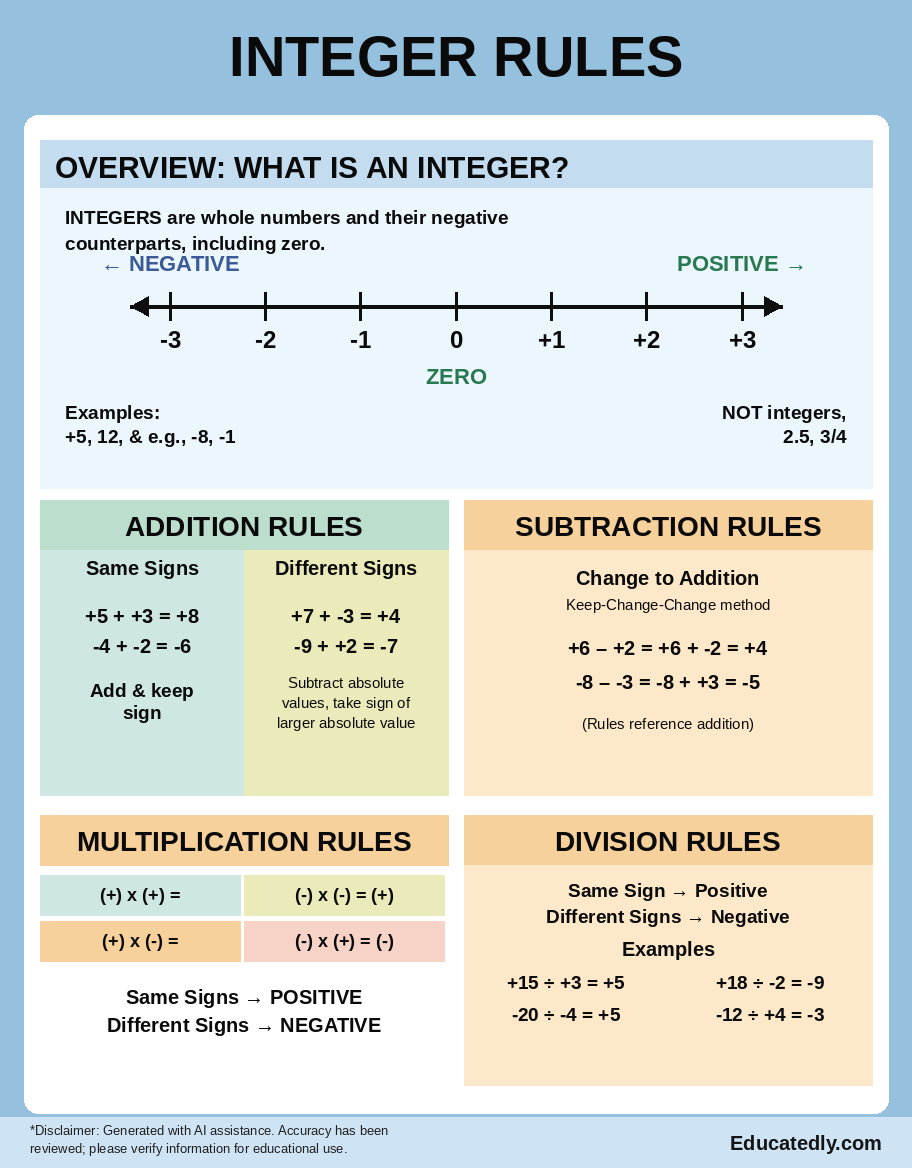
Integers are whole numbers and their negative counterparts, including zero. That means:
- Positive numbers: +1, +2, +3, +12, +100
- Negative numbers: -1, -2, -3, -8, -50
- Zero: 0
Not integers: fractions like ¾, decimals like 2.5, or mixed numbers. If a number has a fractional or decimal part, it’s not an integer — no matter how small that part is.
The Number Line
Integers live on a number line, with zero in the middle, positive numbers extending to the right, and negative numbers extending to the left:
←── NEGATIVE          POSITIVE ──→
 -3  -2  -1   0   +1  +2  +3
The further left a number sits, the smaller its value — which is why -10 is less than -2, even though 10 is bigger than 2 without the negative sign. This trips a lot of people up at first, so it’s worth sitting with: on the number line, “further right” always means “greater,” even in negative territory.
Addition Rules for Integers
Adding integers comes down to one question: are the signs the same, or different?
Same Signs: Add and Keep the Sign
When both numbers have the same sign, add their values together and keep that sign.
- +5 + +3 = +8
- -4 + -2 = -6
Think of it like combining debts or combining gains — two positives make a bigger positive, and two negatives make a bigger negative.
Different Signs: Subtract and Take the Sign of the Larger Number
When the signs are different, subtract the smaller absolute value from the larger one, then use the sign of whichever number had the larger absolute value.
- +7 + -3 = +4 (7 − 3 = 4, and 7 is larger, so the answer is positive)
- -9 + +2 = -7 (9 − 2 = 7, and 9 is larger, so the answer is negative)
Real-world example: If the temperature is -9°F and it rises by 2 degrees, the new temperature is -7°F — the “different signs” rule in action.
Subtraction Rules for Integers
Here’s the key insight that makes subtraction with integers easy: you never actually have to subtract. Instead, change every subtraction problem into an addition problem, then use the addition rules above.
The Keep-Change-Change Method
This is the most common trick for integer subtraction:
- Keep the first number the same
- Change the subtraction sign to an addition sign
- Change the sign of the second number
Then solve it like an addition problem.
Examples:
- +6 − +2 → +6 + −2 = +4
- −8 − −3 → −8 + +3 = −5
Once you rewrite the problem this way, you’re just applying the addition rules you already know. This is the single biggest “aha” moment for most students — subtraction of integers isn’t a new skill, it’s addition in disguise.
Multiplication Rules for Integers
Multiplication (and division, as you’ll see next) follows a simpler pattern than addition and subtraction — it’s all about counting how many negative signs are involved.
| Positive (+) | Negative (−) | |
|---|---|---|
| Positive (+) | (+) × (+) = + | (+) × (−) = − |
| Negative (−) | (−) × (+) = − | (−) × (−) = + |
The simplified rule:
- Same signs → Positive
- Different signs → Negative
Examples:
- +4 × +3 = +12 (same signs → positive)
- −6 × +2 = −12 (different signs → negative)
- −5 × −4 = +20 (same signs → positive)
A helpful way to remember why two negatives make a positive: think of “negative” as “opposite.” The opposite of the opposite of something brings you back to the original direction — hence, positive.
Division Rules for Integers
Division follows the exact same sign pattern as multiplication:
- Same Sign → Positive
- Different Signs → Negative
Examples:
- +15 ÷ +3 = +5 (same signs → positive)
- +18 ÷ −2 = −9 (different signs → negative)
- −20 ÷ −4 = +5 (same signs → positive)
- −12 ÷ +4 = −3 (different signs → negative)
Since multiplication and division share the same sign rule, once you’ve memorized it for one operation, you get the other for free.
Common Mistakes with Integer Rules
- Confusing “same signs” with “same numbers.” The rule cares only about positive/negative, not the size of the numbers.
- Forgetting to flip the sign in Keep-Change-Change. Both the subtraction sign and the sign of the second number change — skipping one of these steps is the #1 source of errors.
- Assuming a negative answer whenever a negative number appears. Two negatives multiplied or divided together give a positive result — a common point of confusion.
- Mixing up “less than” on the number line. Remember: -10 is less than -3, even though 10 > 3.
Frequently Asked Questions
What’s the easiest way to remember integer rules? For addition and subtraction, remember “same signs, add and keep; different signs, subtract and take the bigger sign.” For subtraction specifically, use Keep-Change-Change to turn it into addition. For multiplication and division, remember: same signs make a positive, different signs make a negative.
Why do two negatives make a positive when multiplying? Think of a negative sign as “the opposite of.” The opposite of the opposite of a number returns you to its original, positive direction — which is why multiplying two negatives results in a positive.
Is zero a positive or negative integer? Neither — zero is neutral. It’s the dividing point between positive and negative integers on the number line.
Do the same rules apply to decimals and fractions? The sign rules (same signs vs. different signs) work the same way for all real numbers, not just integers. The difference is that integers are always whole numbers, while decimals and fractions include values between whole numbers.
Quick Reference Summary
- Addition: Same signs → add and keep sign. Different signs → subtract and take the sign of the larger value.
- Subtraction: Keep-Change-Change, then follow addition rules.
- Multiplication & Division: Same signs → positive. Different signs → negative.
Keep this guide alongside the Integer Rules anchor chart for a quick visual reference whenever you need a refresher.
This article was created to accompany the Integer Rules anchor chart. Content generated with AI assistance — please verify against your curriculum standards for classroom use.