What Is Reciprocal Teaching?
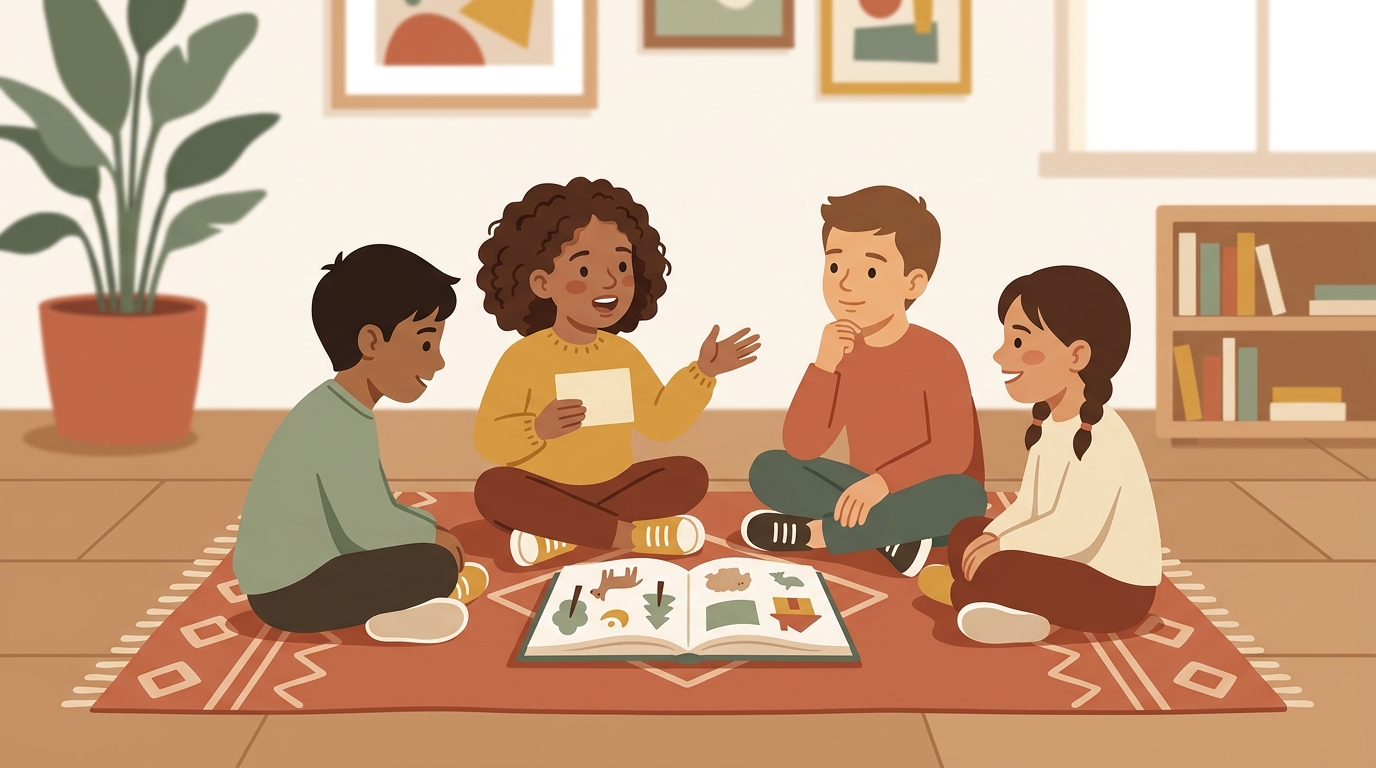
Reciprocal Teaching is a structured way of discussing a text in a small group, where students take turns leading the group through four specific jobs: predicting, questioning, clarifying, and summarizing. Instead of the teacher asking all the comprehension questions, students learn to ask them of each other and of themselves — which is exactly the kind of thinking good readers do automatically in their own heads.
Grade Level
Reciprocal Teaching was originally developed and tested with 7th graders who could decode text just fine but struggled to understand what they’d read — a group researchers call “poor comprehenders.” It’s most useful from about Grade 3 through middle school, once decoding is solid and comprehension becomes the real challenge. It’s not designed for students who are still learning to read the words themselves.
How to Teach It Effectively
The four roles, in order, for each chunk of text:
- Predict — “Based on the title or what just happened, what do you think comes next?”
- Question — Come up with a question a teacher might ask about this section.
- Clarify — Find a confusing word or sentence and work out what it means.
- Summarize — Put the main idea of this section into one or two sentences.
Start with heavy modeling: read a short passage aloud and think through all four roles yourself, out loud, so students see exactly what each one sounds like. Then move into small groups (4–6 students) reading the same short chunk of text, with one student leading the group through the four roles before the group moves to the next chunk and a new student takes the lead.
A Few Tips
Keep the first text chunks short — a paragraph or two — so the four-step routine doesn’t feel overwhelming before it becomes familiar. A simple card listing the four roles in order gives students something to glance at instead of relying on memory alone. And don’t rush to hand over full control — the original research built this skill gradually, with the teacher leading for many sessions before students ran the discussion themselves.
For IEPs/Special Ed Context
This strategy was built specifically for struggling readers, which makes it a strong natural fit for students with reading comprehension difficulties, including many students with learning disabilities. For students who need more scaffolding, shrink the group size, provide sentence starters for each role (“I predict that… because…”, “This is confusing because…”), and consider having a student practice just one role at a time before combining all four.
The Bottom Line
Reciprocal Teaching doesn’t just ask students comprehension questions — it teaches them to ask those questions of themselves. That’s a meaningful difference, and it’s exactly why it was designed for and proven with students who could read the words but were missing the meaning.
Source: Palincsar, A. S., & Brown, A. L. (1984). Reciprocal teaching of comprehension-fostering and comprehension-monitoring activities. Cognition and Instruction, 1(2), 117–175.