What Is Place Value?
Place value is the idea that a digit’s value depends on where it sits in a number. In 47, the 4 isn’t just “four” — it’s four tens, or 40. Swap the digits to 74, and that same 4 is suddenly worth 4 ones. It sounds simple once it clicks, but it’s one of the most commonly misunderstood ideas in early math, because it asks students to hold an abstract rule (“position changes value”) that isn’t obvious just from looking at the numeral.
Grade Level
Place value groundwork starts in Kindergarten (composing and decomposing numbers 11–19 into “a ten and some ones”), becomes the core focus in Grades 1–2 (tens and ones, then hundreds), and keeps expanding through Grades 3–5 as numbers grow larger and decimals get introduced. It’s not a topic you finish — it’s a concept students keep rebuilding at a bigger scale each year.
How to Teach It Effectively
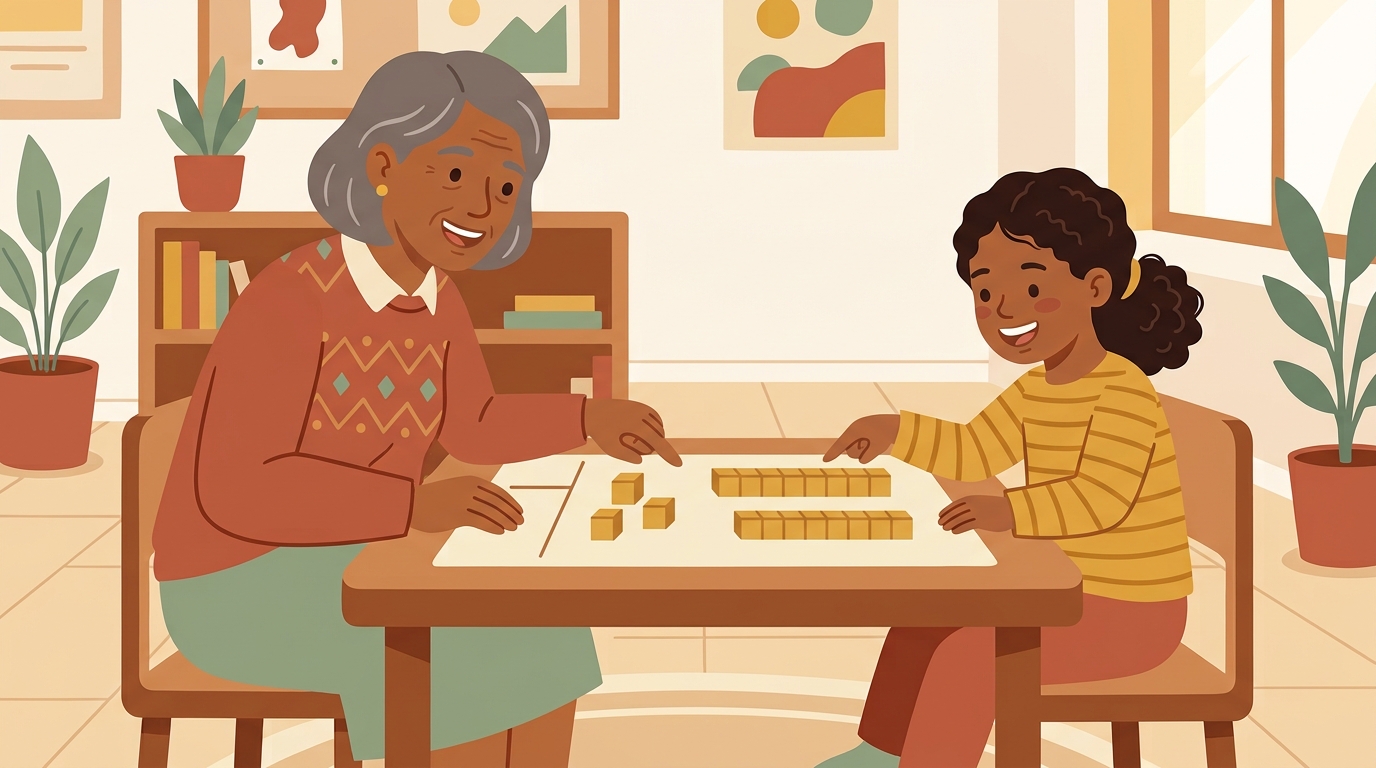
- Base-ten blocks — small unit cubes (ones), rods (tens), and flats (hundreds) let students physically build a number before ever writing it. Build 47 as 4 rods and 7 units, then connect it to the written numeral.
- Bundling — bundle 10 straws or popsicle sticks with a rubber band to make “a ten” from scratch. This builds the why behind trading, not just the mechanics.
- Place value mats — a simple chart with labeled columns (hundreds/tens/ones) gives students a physical “home” for each digit that matches how the number is written left to right.
- Compare with blocks side by side — build 12 and 21 next to each other. Students can see directly that even though both numbers use a 1 and a 2, 21 is bigger because it has 2 tens, not 1.
A Few Tips
Resist moving to worksheets and symbols too quickly. A student can often get place value “right” on paper through memorized steps while still not understanding what’s actually happening — and that gap tends to surface later with multi-digit addition and subtraction. Keep your language consistent (“this rod is one ten,” every time), and don’t be afraid to bring blocks back out for older students who are struggling, even in 3rd or 4th grade — going back to concrete materials isn’t a step backward.
For IEPs/Special Ed Context
A foundational classroom study found that teaching place value and multi-digit addition/subtraction through a base-ten blocks approach led to significantly stronger understanding among 1st and 2nd graders compared to more abstract instruction — including students who struggled with number concepts generally. For students with IEPs, this suggests keeping the concrete stage (blocks, bundles) in play much longer before shifting to pictures or pure symbols, and using consistent, color-coded columns on a place value mat to support students who have difficulty with visual or spatial organization.
The Bottom Line
Almost everything else in multi-digit math — addition, subtraction, rounding, decimals — rests on place value. Letting students physically build numbers with blocks before rushing to expanded form and standard algorithms gives that foundation room to actually set.
Source: Fuson, K. C., & Briars, D. J. (1990). Using a base-ten blocks learning/teaching approach for first- and second-grade place-value and multidigit addition and subtraction. Journal for Research in Mathematics Education, 21(3), 180–206.