Why It Works
Most of us praise students with quick phrases like “good job” or “nice work.” It feels encouraging, but it doesn’t actually tell the student what they did right. Behavior-specific praise (BSP) fixes that by naming the exact behavior: “Nice job raising your hand before you spoke.” Studies have found that this small shift helps students repeat the behavior, because they know precisely what earned the praise — and their classmates learn from hearing it too.
How to Use It
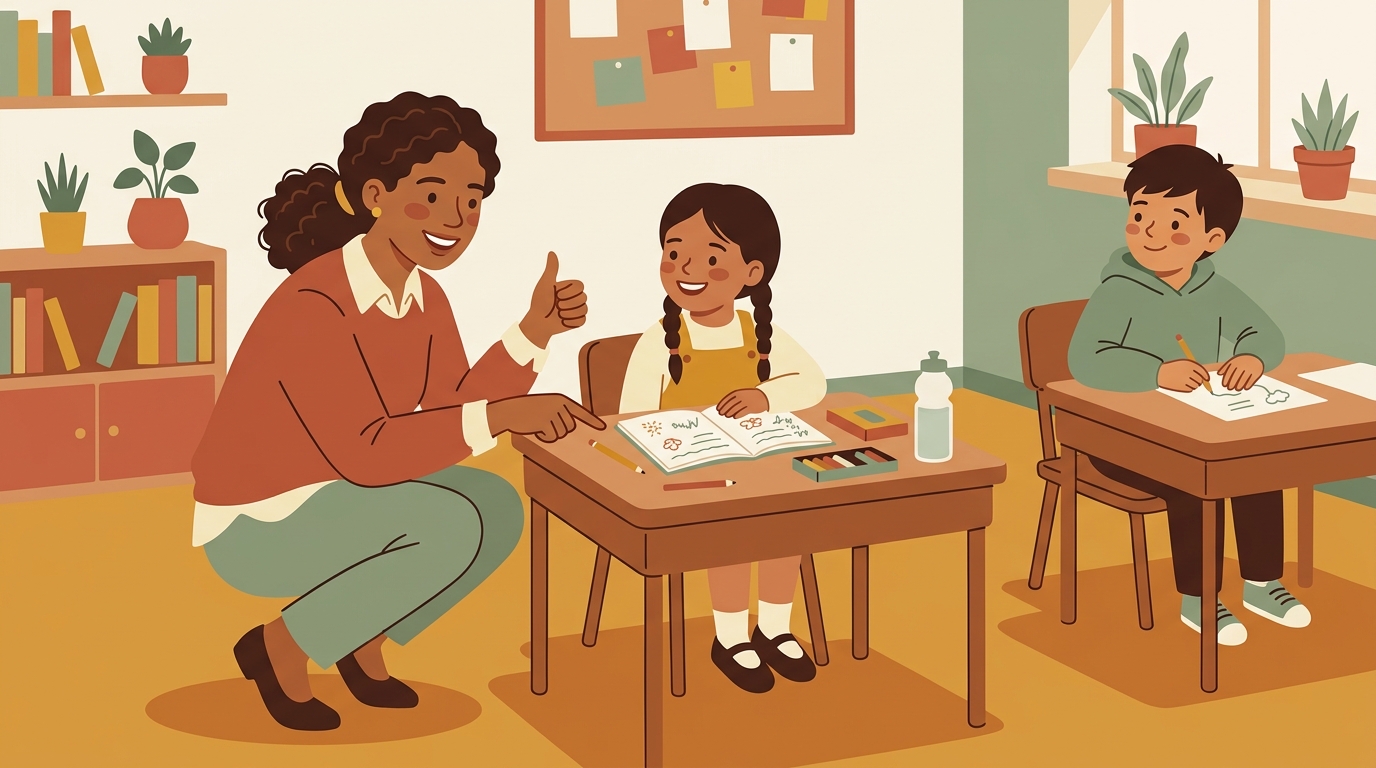
The formula is simple: name the behavior, right after it happens. Instead of “Thank you,” try “Thank you for putting your materials away so quickly.” Instead of “Good job,” try “Good job walking quietly in the hallway.” Aim to catch students doing something right, not just correcting what’s wrong — research suggests a ratio of roughly four positive comments for every corrective one keeps classrooms calmer and more cooperative. BSP works during instruction, transitions, and even hallway or cafeteria supervision, so it doesn’t require a special block of time.
A Few Tips
Keep it brief and genuine — a sentence is plenty. Vary your language so it doesn’t start to sound scripted. Some students prefer a quiet word or a written note over public praise, especially older students, so read the room. And don’t save it for “big” moments; the everyday behaviors (staying seated, using a calm voice, starting work promptly) are exactly what BSP is built for.
For IEPs/Special Ed Context
Behavior-specific praise is especially well-studied with students who have emotional and behavioral disorders, and it pairs naturally with behavior intervention plans that already track specific target behaviors — the praise statement can literally mirror the goal on the IEP (“Great job staying in your seat during the whole lesson”). For students who struggle with transitions or attention, immediate, specific feedback also reduces the guesswork that often triggers frustration or shutdowns.
The Bottom Line
Behavior-specific praise costs nothing, takes seconds, and is one of the most consistently supported classroom management tools in the research. Naming the behavior — not just praising the child — is what makes it stick.
Source: Royer, D. J., Lane, K. L., Dunlap, K. D., & Ennis, R. P. (2018). A systematic review of teacher-delivered behavior-specific praise on K-12 student performance. Remedial and Special Education.