Most teachers can sense when something’s off with a student — but not always in time to do anything about it before the day gets rolling. A short check-in at the door, filled out in under a minute, gives that instinct something concrete to work with.
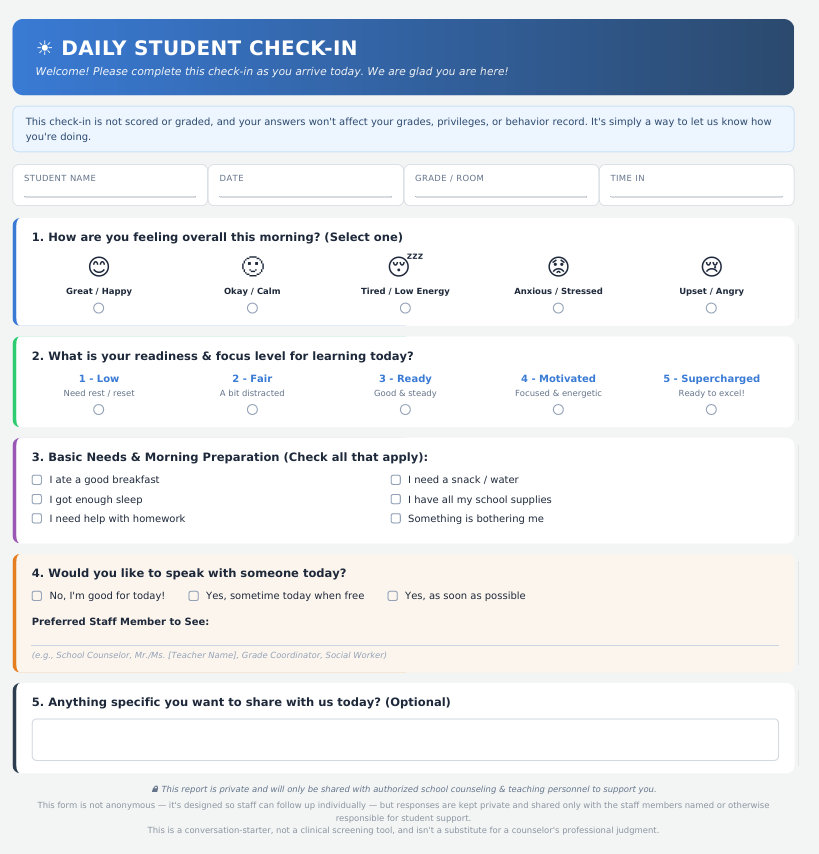
Here’s a free printable Daily Student Check-In form, and a look at how it’s built and why each part is there.
Best for grades 3–12. The form works well from upper elementary through high school, since it asks students to read short phrases independently, rate their own readiness on a numeric scale, and write in a preferred staff member’s name — all things that ask more of a student than a typical K–2 reader can reliably do. For younger grades, a simplified version with just the five mood faces and a single yes/no “want to talk to someone” question tends to work better than trying to stretch this one down.
A quick note on what this is and isn’t: this is a conversation-starter, not a clinical screening tool. It’s designed to prompt a quick, low-stakes check-in — not to diagnose, assess risk, or replace a counselor’s professional judgment. A student answering “fine” on a hard day, or “upset” on an ordinary one, doesn’t tell you everything; treat it as one data point among many, not a verdict. Unlike a behavior tracker or point system, this form isn’t measuring conduct or tied to any reward or consequence — it’s meant to surface how a student is doing, not how they’re performing.
What’s on the form
The form opens with basic identifying fields — name, date, grade/room, and time in — so it can double as a quick attendance-adjacent record if a school wants to track patterns over time.
From there, it asks five things:
1. How are you feeling this morning? Five options, from “Great / Happy” to “Upset / Angry,” each with a simple face icon. No paragraph required — just a box to check.
2. Readiness and focus level, on a 1–5 scale. This is separate from mood on purpose. A student can feel emotionally fine but still show up running on no sleep, or feel anxious but still be ready to focus. Separating the two gives teachers a more useful signal than a single “how are you” question would.
3. A basic needs checklist. Ate breakfast, has school supplies, got enough sleep, needs a snack or water, needs help with homework, or — the one that matters most — “something is bothering me.” These are the kinds of things that quietly tank a kid’s morning and are easy for staff to miss if no one asks directly.
4. Whether they’d like to talk to someone, and who. Three options: not today, sometime today, or as soon as possible — plus a blank line for a preferred staff member. That last part matters more than it might seem. A student is far more likely to actually follow through on asking for help if they get to name the adult they trust, rather than being routed to whoever’s on duty.
5. An open, optional line for anything else. No prompt beyond “anything you want to share.” Some students won’t use it. Some will use it for the one thing they came in hoping someone would ask about.
At the bottom, the form states plainly that responses are private and go only to authorized counseling and teaching staff — a small line, but one worth keeping visible, since students are more likely to answer honestly if they know exactly who sees it. Worth being upfront that the form isn’t anonymous — it asks for a name so staff can follow up individually — but it’s also not scored or graded, and answers don’t affect grades, privileges, or a behavior record.
Why bother with a form instead of just watching for signs
Teachers already read the room. The form isn’t a replacement for that — it’s a way to catch the students who don’t show it. A kid who’s quietly anxious or dealing with something at home doesn’t always look different from the outside. A 60-second form gives them a low-stakes way to say so without having to raise a hand or start a conversation in front of classmates.
It also creates something a purely observational approach can’t: a record. If the same student checks “anxious” or “something is bothering me” three mornings in a row, that’s a pattern worth a counselor’s attention — one that’s easy to miss if it’s living only in individual teachers’ memories.
Using it day to day
A workable routine looks something like this: forms go out as students arrive, get a quick scan during attendance so anything urgent (a student requesting to talk “as soon as possible,” for instance) gets flagged right away, and anything less urgent gets passed along to the counseling team by mid-morning. It doesn’t need to be more complicated than that to be useful.
One caveat worth being honest about: this only works if responses are actually reviewed daily. If your team can’t commit to reviewing forms same-day, a lower-frequency version — twice a week, say — will serve students better than a daily one that ends up sitting unread.
The form is free to download and print for classroom or school-wide use.