
Contractions: Combining Two Words Into One
3-5
1
Teacher Note: Students can watch the video lesson above and answer the questions. Click the “Teacher Answer Key” dropdown below when you are ready to review the solutions!
Key Concepts:
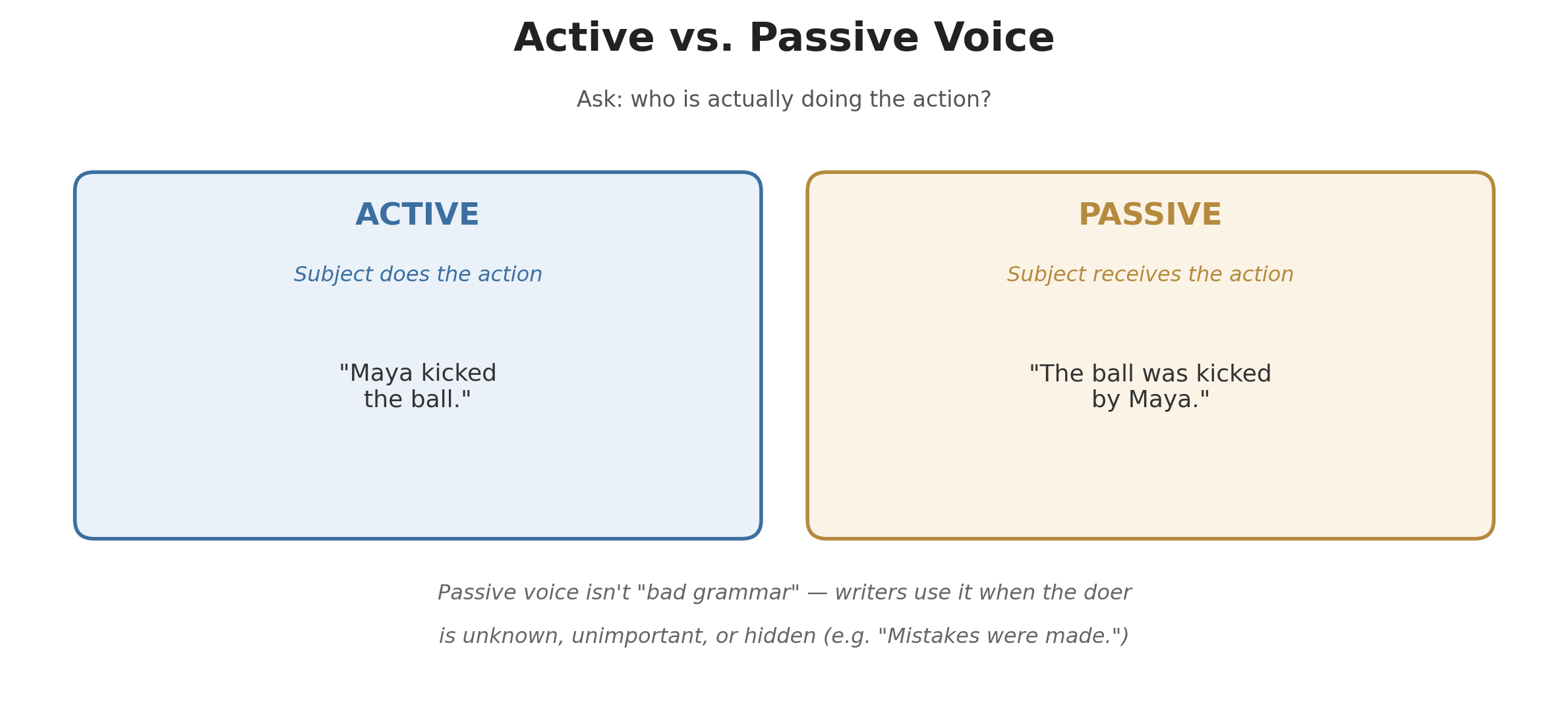
• Active Voice: The subject does the action, following a subject-verb-object pattern (e.g. “Maya kicked the ball.”).
• Passive Voice: The subject receives the action (e.g. “The ball was kicked by Maya.”).
• The Test: Ask “Who is actually doing the action?” If the subject does it, it’s active. If the subject receives it, it’s passive.
• Passive Isn’t “Wrong”: Writers use passive voice when the doer is unknown, unimportant, or hidden.
Instructions: Read each question carefully and write your answer in the space provided.
1. The dog.
2. “The cat was chased by the dog.”
3. Passive — the subject (the ball) is receiving the action, not doing it.
4. “Who is actually doing the action?”
5. When the doer is unknown, unimportant, or hidden.
6. Answers will vary — check that the active sentence follows subject-verb-object, and the passive version correctly flips the structure (e.g. “was ___ by ___”).
Disclaimer: This worksheet was generated with AI assistance based on original video content. It is intended for educational reference only. Teachers are encouraged to review and adjust questions to fit their curriculum standards before classroom use.
🎯 Extension Activity: Give students 6 sentences (a mix of active and passive) and have them label each, then find a real example of passive voice used intentionally (e.g. in a news headline or scientific writing) and explain why the writer might have hidden the doer.