
Parallel and Perpendicular Lines: Do They Cross?
3-5
1
Teacher Note: Students can watch the video lesson above and answer the questions. Click the “Teacher Answer Key” dropdown below when you are ready to review the solutions!
Key Concepts:
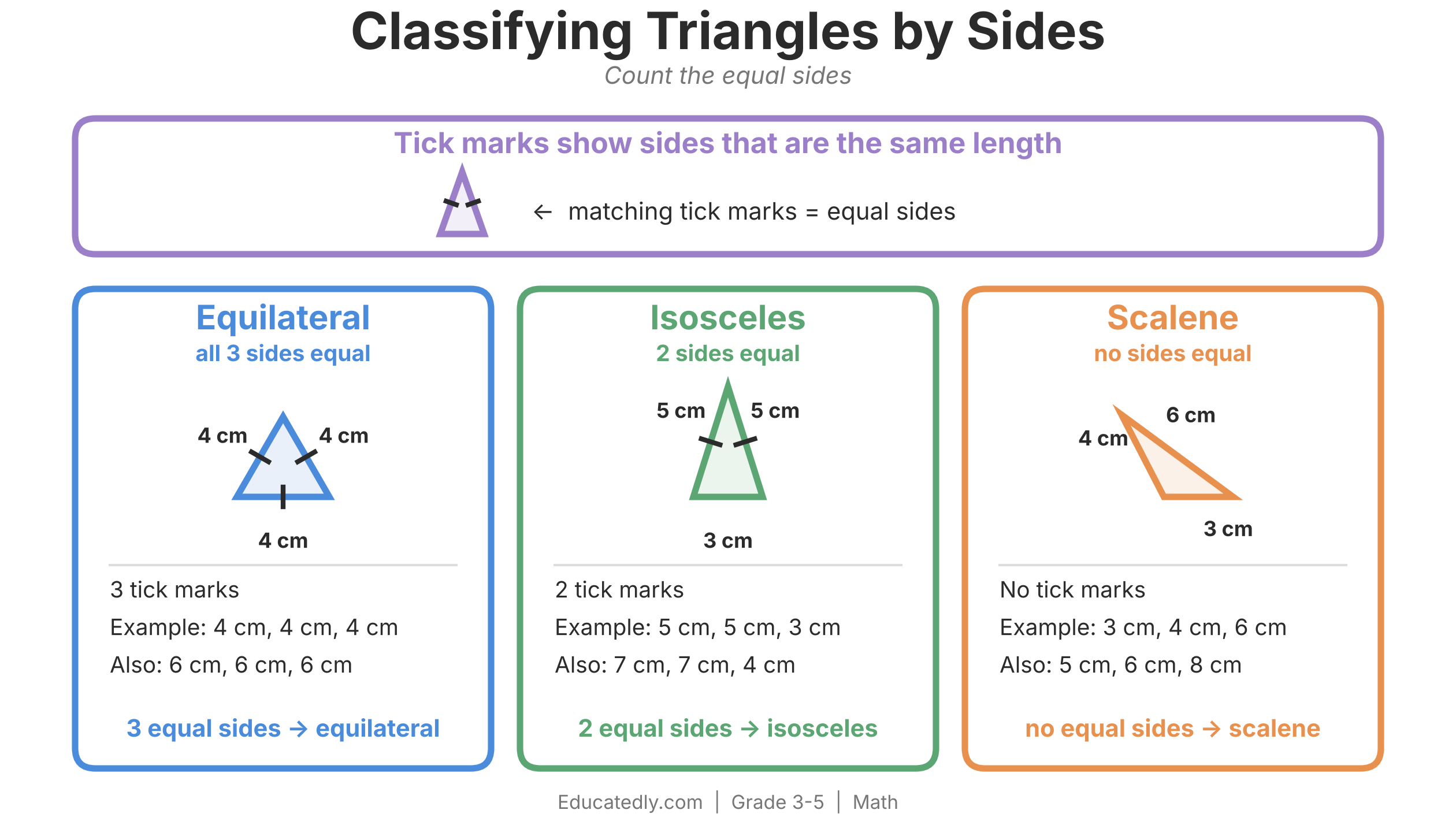
• Tick Marks: Small lines drawn on the sides of a shape to show which sides are the same length.
• Equilateral Triangle: All 3 sides are equal.
• Isosceles Triangle: 2 sides are equal.
• Scalene Triangle: No sides are equal. Every side is a different length.
Instructions: Read each question carefully and write your answer in the space provided.
1. They show which sides are the same length. @ 0:13
2. Equilateral, because all 3 sides are equal. @ 0:23
3. Isosceles, because 2 sides (7 cm and 7 cm) are equal. @ 1:04
4. Scalene, because no sides are equal. @ 1:11
5. Isosceles. @ 0:33
6. Isosceles. The two 9 cm sides get tick marks. (Application question — not shown in the video)
Disclaimer: This worksheet was generated with AI assistance based on original video content. It is intended for educational reference only. Teachers are encouraged to review and adjust questions to fit their curriculum standards before classroom use.
🎯 Extension Activity: Give each student five straws or paper strips: three cut to 4 cm, one to 6 cm, and one to 8 cm. Have them build an equilateral triangle (4, 4, 4), an isosceles triangle (4, 4, 6), and a scalene triangle (4, 6, 8), then draw each one and add tick marks to the equal sides.