
Parallel and Perpendicular Lines: Do They Cross?
3-5
1
Teacher Note: Students can watch the video lesson above and answer the questions. Click the “Teacher Answer Key” dropdown below when you are ready to review the solutions!
Key Concepts:
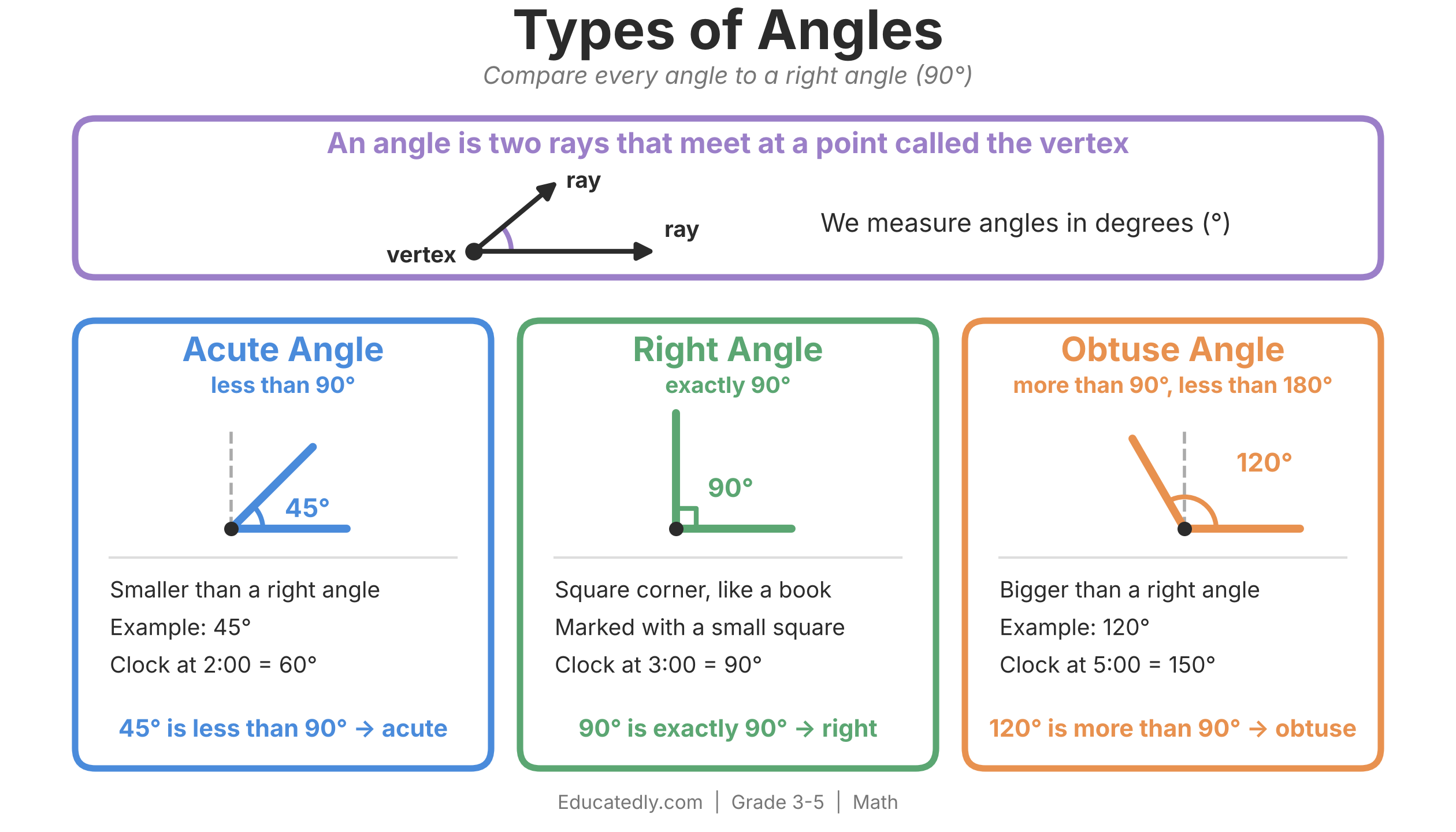
• Angle: Two rays that meet at a point called the vertex. Angles are measured in degrees (°).
• Right Angle: Exactly 90°. It looks like the corner of a square and is marked with a small square at the vertex.
• Acute Angle: Less than 90°, smaller than a right angle.
• Obtuse Angle: More than 90° but less than 180°, bigger than a right angle.
Instructions: Read each question carefully and write your answer in the space provided.
1. The vertex. @ 0:09
2. Exactly 90°. @ 0:15
3. Acute, because 45° is less than 90°. @ 0:28
4. Obtuse, because 120° is more than 90° but less than 180°. @ 0:38
5. 150°, which is obtuse. @ 0:55
6. 120° (4 hour marks × 30° = 120°), which is obtuse. (Application question — not shown in the video)
Disclaimer: This worksheet was generated with AI assistance based on original video content. It is intended for educational reference only. Teachers are encouraged to review and adjust questions to fit their curriculum standards before classroom use.
🎯 Extension Activity: Give each student the corner of an index card as a "90° tester." Have them hunt for angles around the classroom, hold the card corner against each one, and record whether it's acute, right, or obtuse in a three-column chart.