
Parallel and Perpendicular Lines: Do They Cross?
3-5
1
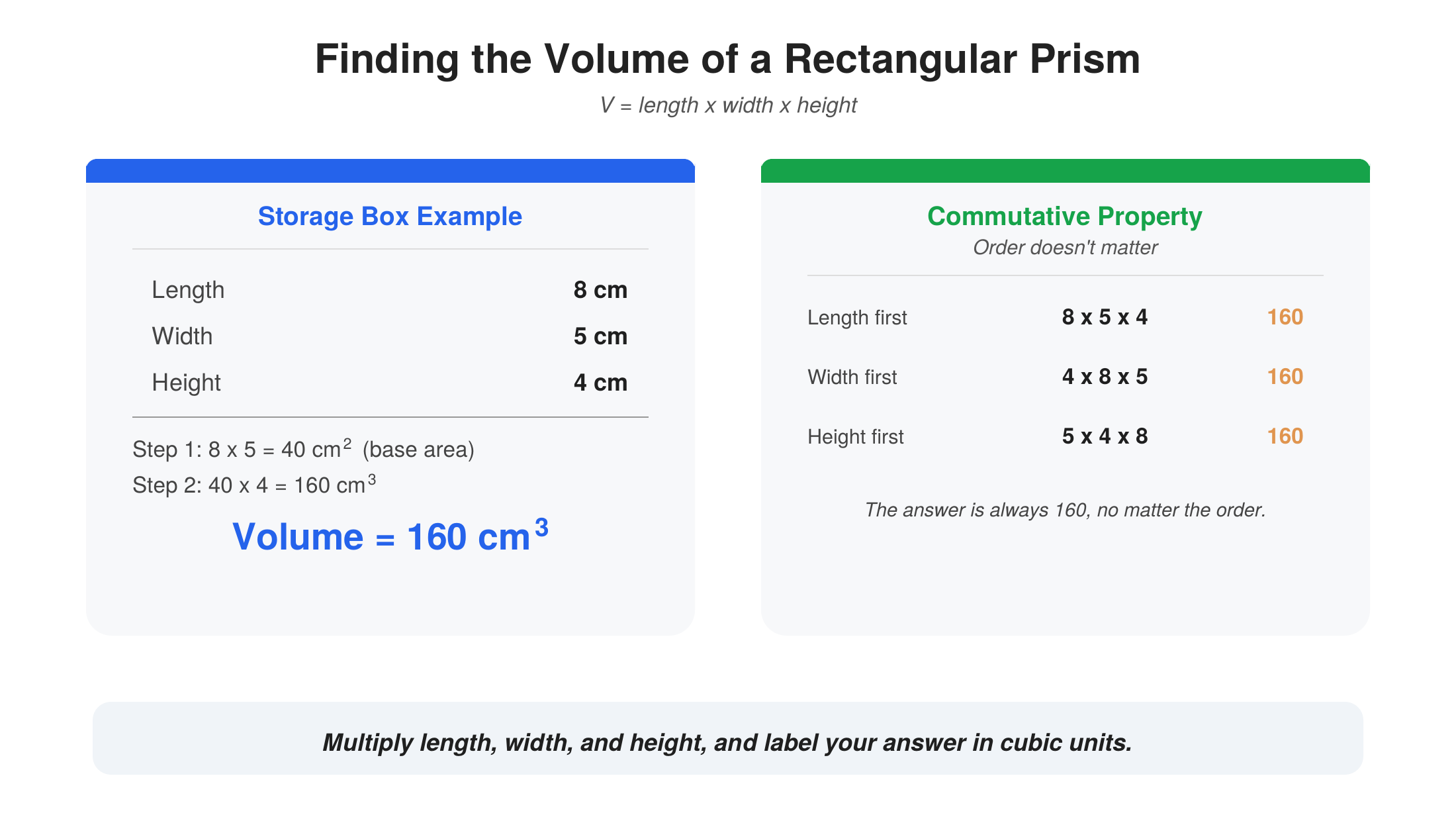
Teacher Note: Students can watch the video lesson above and answer the questions. Click the “Teacher Answer Key” dropdown below when you are ready to review the solutions!
Key Concepts:
• Volume: How much space a three-dimensional shape takes up, measured in cubic units.
• The Formula: V = length × width × height.
• Commutative Property: Multiplying the three dimensions in any order gives the same volume.
Instructions: Read each question carefully and write your answer in the space provided.
1. 8 × 5 = 40, 40 × 4 = 160 cubic centimeters.
2. Cubic units (e.g., cubic centimeters, cubic inches).
3. Yes — 5 × 4 × 8 = 160, the same answer, because of the commutative property.
4. Any two: how much water a fish tank holds, how much fits in a moving box, how much water a swimming pool holds.
5. 10 × 6 = 60, 60 × 5 = 300 cubic centimeters.
6. Answers will vary; accept any reasonable explanation referencing that multiplication can be done in any order and still reach the same product.
Disclaimer: This worksheet was generated with AI assistance based on original video content. It is intended for educational reference only. Teachers are encouraged to review and adjust questions to fit their curriculum standards before classroom use.
🎯 Extension Activity: Measure a real box or container at home or in the classroom (in centimeters or inches), then calculate its volume using V = length × width × height.