
Parallel and Perpendicular Lines: Do They Cross?
3-5
1
Teacher Note: Students can watch the video lesson above and answer the questions. Click the “Teacher Answer Key” dropdown below when you are ready to review the solutions!
Key Concepts:
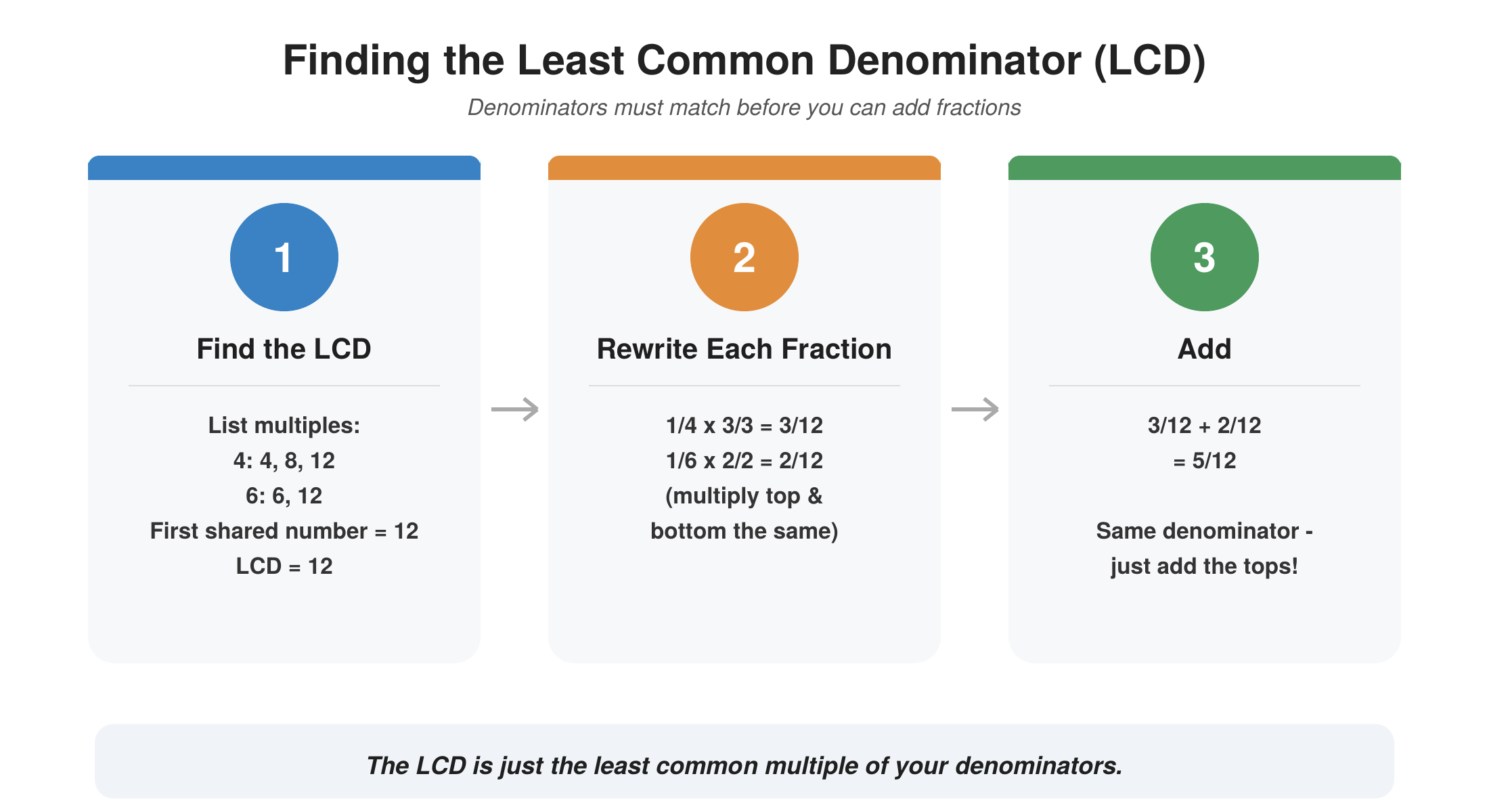
• Why it matters: Denominators must match before you can add fractions — the pieces have to be the same size.
• LCD: The Least Common Denominator is the least common multiple of the denominators.
• The steps: List multiples of each denominator, find the first one they share, rewrite each fraction with that denominator, then add.
Instructions: Read each question carefully and write your answer in the space provided.
1. The pieces are different sizes (fourths vs. sixths), so they can’t be combined until the denominators match.
2. The LCD is the least common multiple of the denominators — the smallest number both denominators divide into evenly.
3. Multiples of 4: 4, 8, 12. Multiples of 6: 6, 12. The first shared number is 12, so the LCD is 12.
4. 1/4 x 3/3 = 3/12. 1/6 x 2/2 = 2/12.
5. 3/12 + 2/12 = 5/12.
6. LCD of 3 and 5 is 15. 1/3 x 5/5 = 5/15. 1/5 x 3/3 = 3/15.
Disclaimer: This worksheet was generated with AI assistance based on original video content. It is intended for educational reference only. Teachers are encouraged to review and adjust questions to fit their curriculum standards before classroom use.
🎯 Extension Activity: Give students 3 pairs of fractions with different denominators (like 1/2 and 1/5, or 2/3 and 1/4). Have them find the LCD for each pair, rewrite both fractions, and add them together.