
Converting Between Fahrenheit and Celsius: A Step-by-Step Guide
6-8
2
Teacher Note: Students can watch the video lesson above and answer the questions. Click the “Teacher Answer Key” dropdown below when you are ready to review the solutions!
Key Concepts:
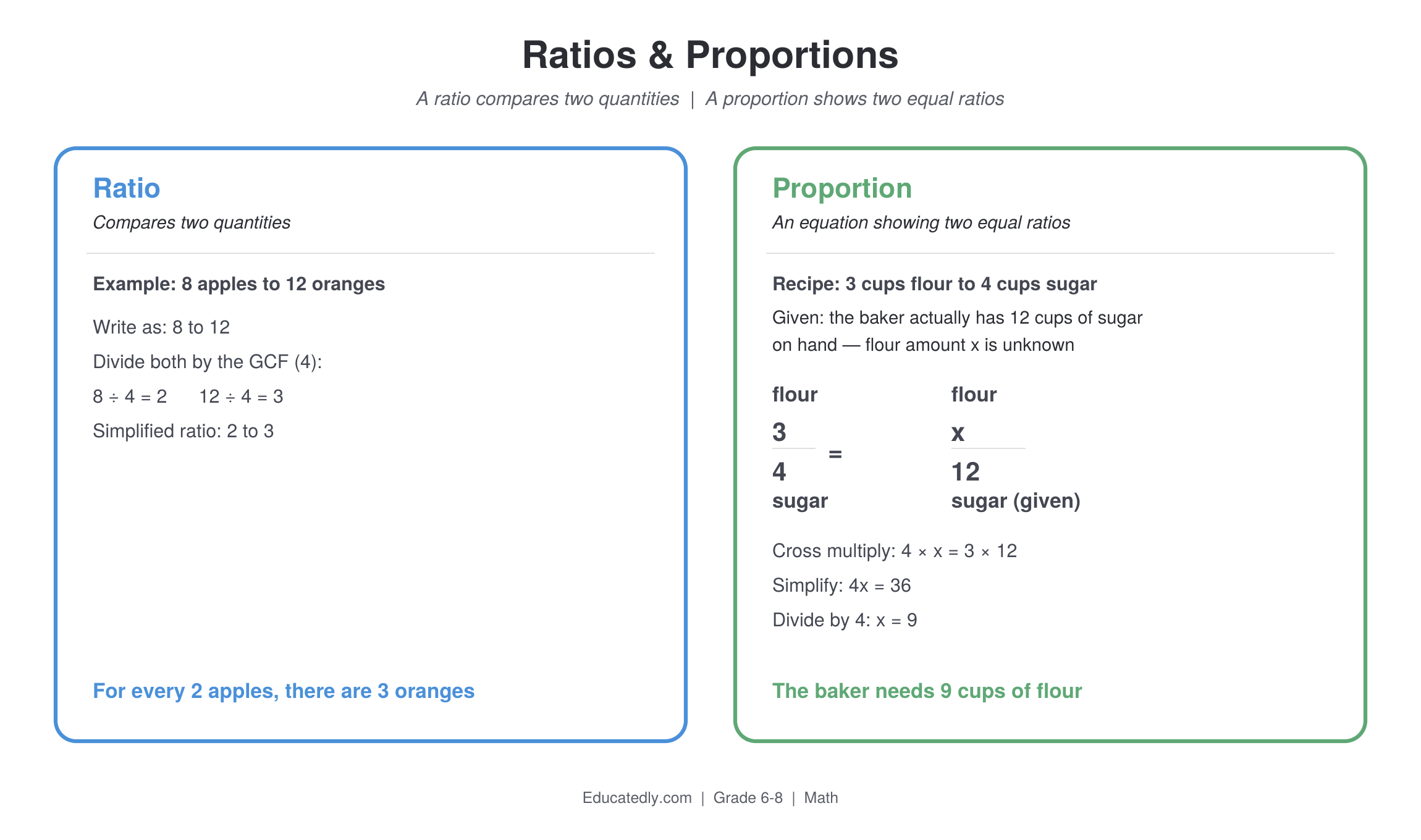
• Ratio: A ratio compares two quantities, such as 8 apples to 12 oranges.
• Simplifying Ratios: Divide both numbers in a ratio by their greatest common factor to write it in simplest form.
• Proportion: A proportion is an equation showing that two ratios are equal.
• Cross Multiplication: To solve a proportion for an unknown value, cross multiply, then simplify and divide to isolate the variable.
Instructions: Read each question carefully and write your answer in the space provided.
1. 8 to 12, simplified using a GCF of 4, gives 2 to 3.
2. For every 2 apples, there are 3 oranges.
3. A proportion is an equation showing two equal ratios.
4. 3/4 = x/12. Cross multiply: 4 × x = 3 × 12, so 4x = 36. Divide by 4: x = 9.
5. The baker needs 9 cups of flour.
Disclaimer: This worksheet was generated with AI assistance based on original video content. It is intended for educational reference only. Teachers are encouraged to review and adjust questions to fit their curriculum standards before classroom use.
🎯 Extension Activity: Find a recipe that serves 4 people and rewrite the ingredient amounts as a proportion to serve 10 people instead. Solve for each missing ingredient amount using cross multiplication.