
Earth’s Hidden Layers: What’s Inside Our Planet?
3-5
2
Teacher Note: Students can watch the video lesson above and answer the questions. Click the “Teacher Answer Key” dropdown below when you are ready to review the solutions!
Key Concepts:
• Force & Work: A force is a push or a pull, and work happens when a force moves something.
• Simple Machines: Tools that make work easier by changing the amount of force needed or the direction of the force.
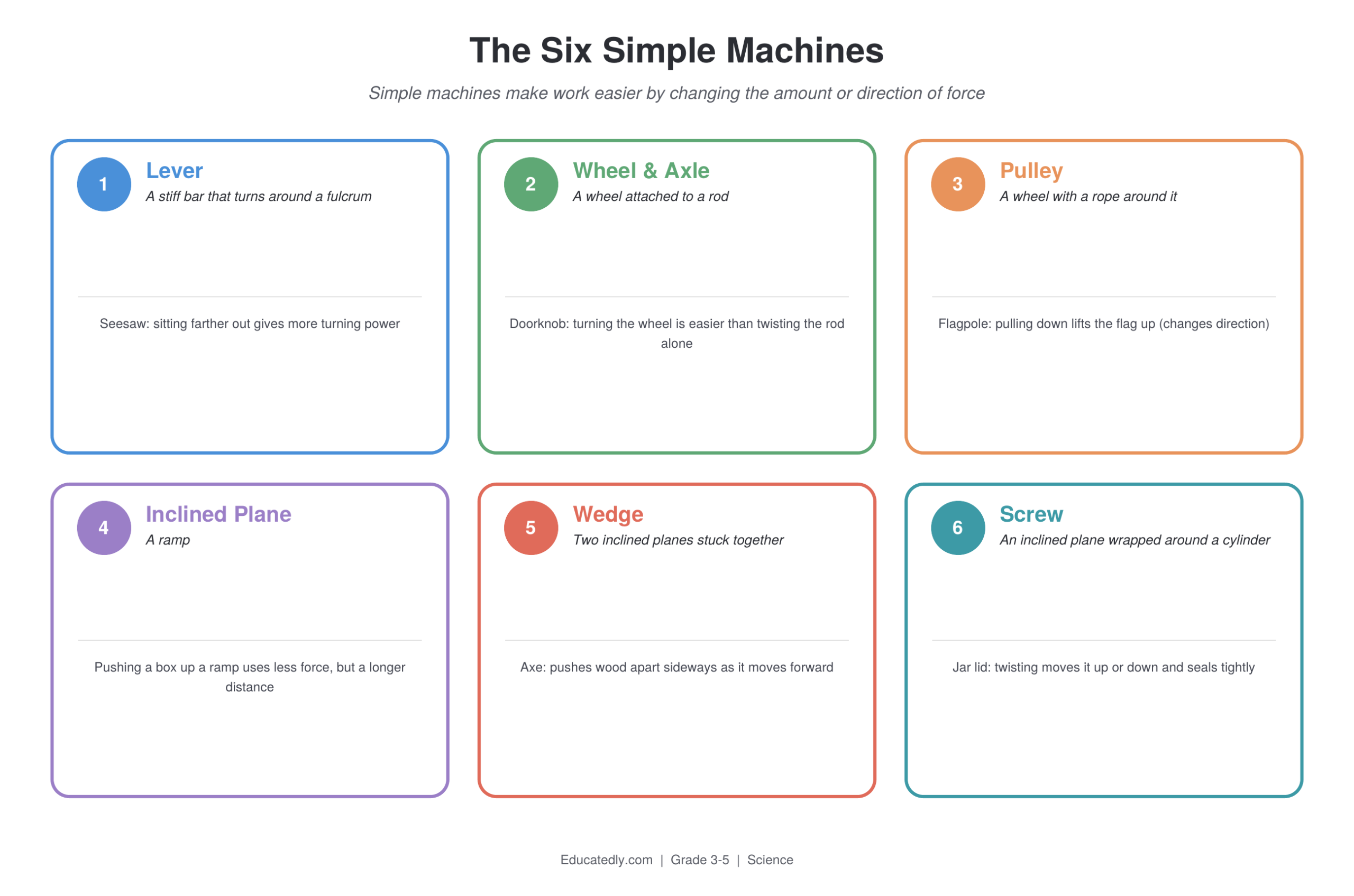
• The Six Types: Lever, wheel and axle, pulley, inclined plane, wedge, and screw.
• Trade-Offs: Some simple machines, like an inclined plane, reduce the force needed but require moving the object a longer distance.
Instructions: Read each question carefully and write your answer in the space provided.
1. A lever is a stiff bar that turns around a point called a fulcrum.
2. A doorknob — turning the large knob is much easier than trying to twist the tiny rod (axle) by itself.
3. A pulley changes the direction of force — pulling down on the rope lifts the flag up.
4. You use less force to push the object up the ramp, but you have to move it a longer distance.
5. A wedge is like two ramps stuck together — when the axe moves forward into wood, the wedge shape pushes the wood apart sideways.
6. A screw is an inclined plane wrapped around a cylinder — twisting a jar lid moves it up or down and helps seal the jar tightly.
Disclaimer: This worksheet was generated with AI assistance based on original video content. It is intended for educational reference only. Teachers are encouraged to review and adjust questions to fit their curriculum standards before classroom use.
🎯 Extension Activity: Find one example of a simple machine somewhere in your home that wasn't mentioned in the video. Identify which of the six types it is and explain how it makes work easier.