
Earth’s Hidden Layers: What’s Inside Our Planet?
3-5
2
Teacher Note: Students can watch the video lesson above and answer the questions. Click the “Teacher Answer Key” dropdown below when you are ready to review the solutions!
Key Concepts:
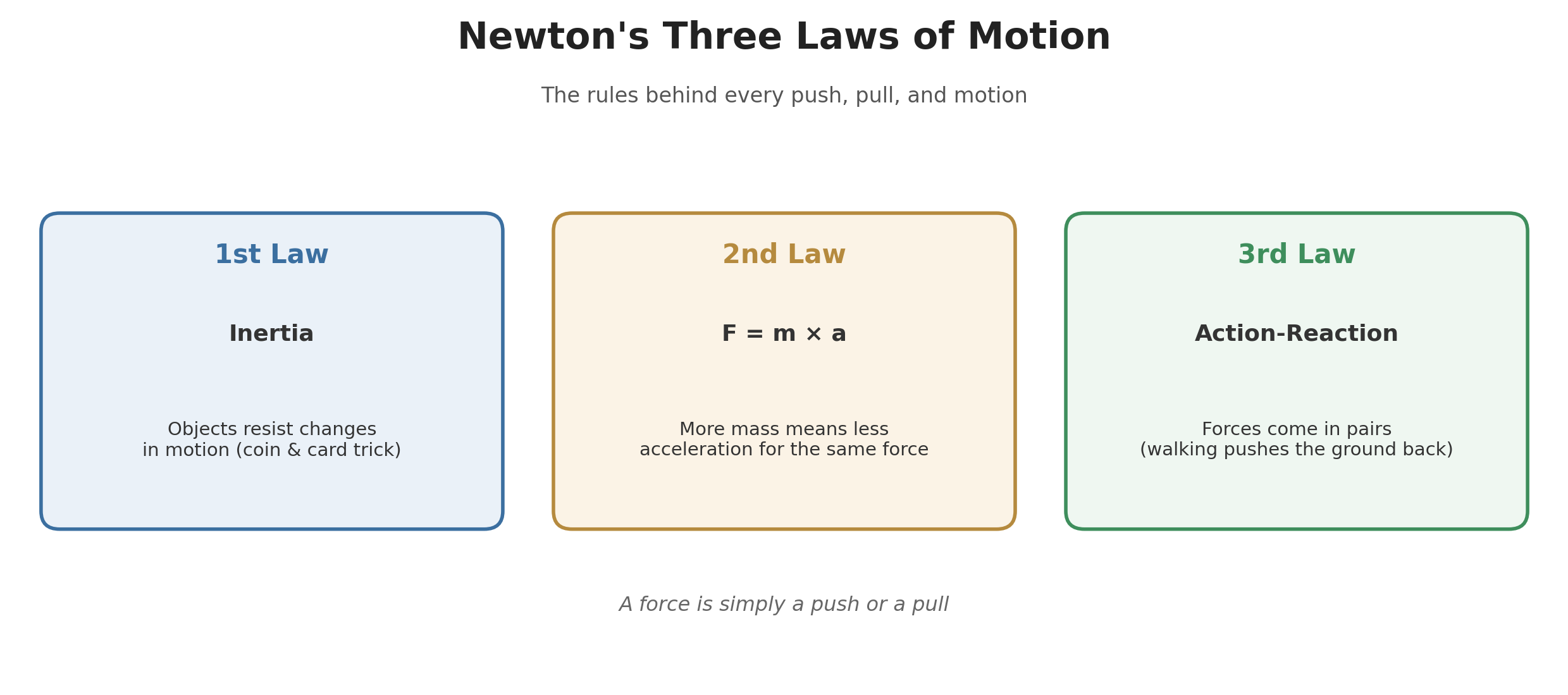
• First Law (Inertia): Objects resist changes in motion. A moving object needs a force (like friction) to slow it down — motion doesn’t just “run out.”
• Second Law: F = m × a. The same force produces less acceleration on an object with more mass.
• Third Law: Forces come in pairs. When you push on something, it pushes back on you with equal force.
Instructions: Read each question carefully and write your answer in the space provided.
1. The coin’s inertia keeps it in place (resisting a change in motion) while the fast-moving card slides out from under it.
2. Friction from the grass pushes against it, slowing it down.
3. Balanced forces cause no change in motion; unbalanced forces change speed or direction.
4. F = m × a (Force equals mass times acceleration).
5. The full cart has more mass, so the same force produces less acceleration.
6. The ground pushes back on your foot (an equal and opposite reaction to your foot pushing backward on the ground).
Disclaimer: This worksheet was generated with AI assistance based on original video content. It is intended for educational reference only. Teachers are encouraged to review and adjust questions to fit their curriculum standards before classroom use.
🎯 Extension Activity: Have students find and describe 3 examples of Newton's Laws in their own daily life (e.g., seatbelts and inertia, pushing a heavy vs. light backpack, a swimmer pushing off a pool wall) and identify which of the three laws each example demonstrates.