
The Plant Life Cycle
K-2
1
Teacher Note: Students can watch the video lesson above and answer the questions. Click the “Teacher Answer Key” dropdown below when you are ready to review the solutions!
Key Concepts:
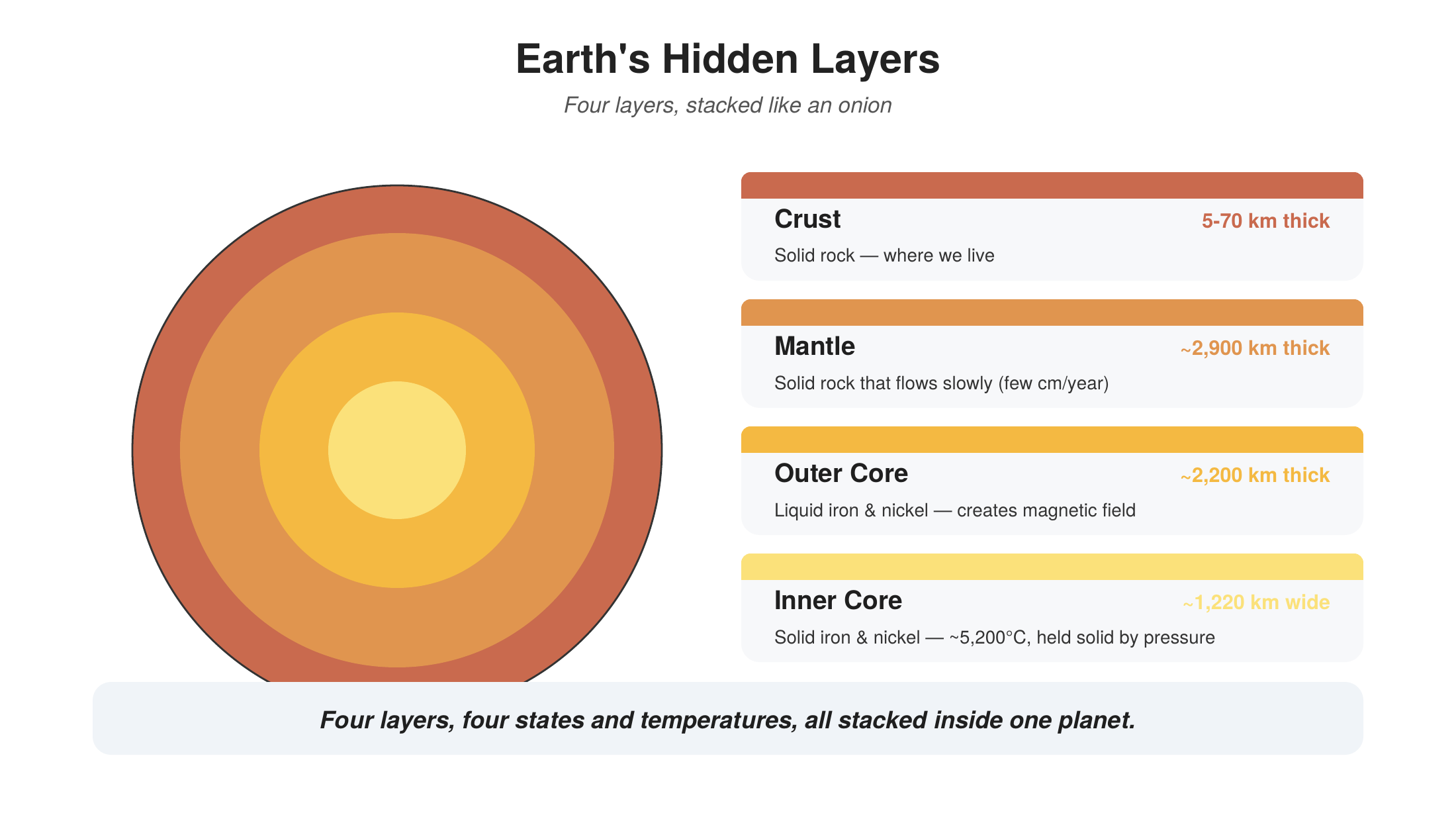
• Crust: Earth’s thin, outermost layer of solid rock, about 5-70 km deep, where we live.
• Mantle: Earth’s thickest layer (~2,900 km), mostly solid rock that flows extremely slowly due to intense heat.
• Outer Core: A ~2,200 km layer of liquid iron and nickel whose movement creates Earth’s magnetic field.
• Inner Core: A solid ball of iron and nickel (~1,220 km wide) at Earth’s center, kept solid by extreme pressure despite temperatures around 5,200°C.
Instructions: Read each question carefully and write your answer in the space provided.
1. Crust, mantle, outer core, inner core.
2. The crust is the thinnest layer, about 5 to 70 kilometers deep.
3. Intense heat makes the solid rock flow extremely slowly, moving only a few centimeters a year.
4. The swirling liquid metal in the outer core creates Earth’s magnetic field, which is what makes a compass point north.
5. The pressure from all the layers above it is so intense that it keeps the inner core solid despite the extreme heat.
6. The crust; answers will vary on the second part, but should reference that it’s where we build cities, grow food, and live.
Disclaimer: This worksheet was generated with AI assistance based on original video content. It is intended for educational reference only. Teachers are encouraged to review and adjust questions to fit their curriculum standards before classroom use.
🎯 Extension Activity: Try drawing and labeling your own cross-section of Earth from memory, then check it against the video. Can you remember all four layers and one fact about each?